Thinking tool: Think in public

When you've done or figured something out: write it where others can see, whether that's on Twitter, Substack, your personal website, or stapled to trees around your neighbourhood. (Some of these may be better than others.)
You get critiques (free error-correction), and opportunities come to you rather than the reverse - Henrik Karlsson describes a blog post as a very long search query to find fascinating people.
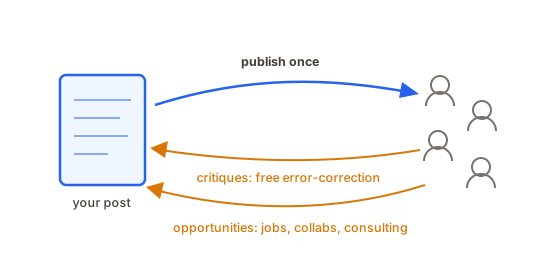
Opportunities may come to you if you're creating good public outputs. Building up your profile and reputation takes time, but it often pays dividends for quite a while. This is almost analogous to "passive income": effort put in now generates "passive opportunities" in future.
As an example, I've written up a lot of blog articles on concentration of power risks from AI. Because not that many other people think about this deeply, I've received many invites to speak at conferences, attend exclusive events, and had some people reach out trying to headhunt me for this specifically. (I've done other things that might have led to some of these reach outs too, so it's hard to attribute fully to this. But I'm pretty confident that some of it is counterfactually because I have some form of public presence.)
You don't need to be an expert in an area to write in public! Even just creating a trail of learning exhaust can be surprisingly helpful. (And often it turns out you accidentally become an expert in an extremely narrow niche, if you're doing interesting stuff.)
For example, I was a novice user of Keycloak, a piece of software that can act as a login platform. I spun it up for a small side project, and struggled to get it sending email confirmations. I eventually figured it out and wrote a short blog on it. A few months later, someone read this and reached out offering me $750 for an hour consulting to help them with a closely related Keycloak problem. (Offers like this are rare and unpredictable, and I'm not saying this is a particularly "amazing" outcome. But it serves to illustrate that even a novice making one simple "learning exhaust" post can lead to interested people reaching out.)
Working in public boosts the reach of your ideas. If you're doing good stuff, you might want the appropriate people to see it. But often it's hard to know exactly who will benefit from your writing, or it might be hard to reach them directly.
Publishing work allows organic discovery and sharing of your ideas - especially if they're indexed by a search engine like Google, or perhaps nowadays it might matter more that the ideas within are surfaced by LLMs.
Freely publishing your ideas might also put them at a surprising advantage compared to "official" sources like scientific journals because many people get blocked by paywalls!
Finally, working in public helps you pursue specific opportunities, because you'll have a legible portfolio of relevant projects available for immediate inspection.
Interview processes struggle to figure out what people are really like and whether they have deep expertise in the area. This is why a lot of organisations rely heavily on referrals.
From the perspective of a hiring manager, it is a very strong positive signal to see someone has publicly verifiable expertise. Especially at initial CV screening, having relevant public work tends to be a much stronger signal than a bunch of bullet points claiming you've done something maybe impressive that I can't verify.
Related concepts
This is part of my thinking tools series. Also consider:
- Create surface area for luck: doing more is what gives you something worth publishing
- Be disagreeable: concrete public claims are what make the free error-correction possible
- Adopt a scout mindset: public critique is the cheapest error-correction available, if you actually want it