Thinking tool: Be disagreeable

"Be disagreeable" is my (allegedly) better version of "strong opinions, loosely held": express opinions people can actually disagree with - and update honestly when they do.
This is because to improve yourself, or anything really, you'll need to learn things. And to learn, you:
- Start with no belief and form one; or
- More commonly, update existing beliefs
It's usually easier to form initial beliefs about a topic than to update them. Being disagreeable makes updating easier:
-
Hold concrete beliefs: by concrete, I mean "easy to be proven wrong or argue against". Vague beliefs are much harder to prove wrong.
Vague beliefs often live as unexamined vibes. For example, a developer hears a product is built on PHP and concludes it must be bad, where the underlying reasoning is something like "hmm, PHP → everyone jokes about PHP → this must be janky".
If you're not sure where to start, writing out beliefs forces you to make them explicit, which can expose the murky reasoning. Try to state your beliefs in their most raw and direct form.
AI tools like Claude can give useful critiques of your writing, including prodding where bits are still kind of vague or having a back-and-forth about your ideas. Warning: today's LLMs are bad at keeping opinions sharp, so I'd advise against using them to write down or summarize your position.
You can make vague beliefs more specific. For example, "Customers just don't understand us" might become "Prospective customers getting to our landing page don't have a good sense of how much their current solution is costing them, and therefore aren't incentivised to switch to our product." Suddenly there are specific claims that can be tested.
-
Express your beliefs: Given concrete beliefs are easy to prove wrong, expressing them and inviting productive disagreement is a great way to learn new things. Perhaps for fear of being wrong, people often keep their beliefs to themselves. But you should strive to be proven wrong more often (kinda) - this means you're able to learn things! Thinking in public can help with this.
It also helps to explain how you got to your beliefs. If people are far from your position, they might not even know how to engage - sharing the specific numbers you've seen, or linking primary sources, makes critiquing much easier. Really, empathy is (as always) an excellent skill here - if you were in the critiquer's position, what would make it easy?
For example, I'll often note down my understanding of something at work and share that document, making clear that it's my guess of things and highlighting where I'm most uncertain. This leads to a bunch of helpful comments that refine my understanding.
Even in the rare case where there aren't many corrections, I learn I can be confident in my beliefs, and continue with more gusto into my plans, without wasting effort hedging against having the wrong understanding.
-
Update honestly: As with a scout mindset, actually listen to the evidence presented to you and evaluate how it changes your beliefs.
Tips
Hold probabilities of different concrete beliefs. For example, on whether a project will be delivered on time:
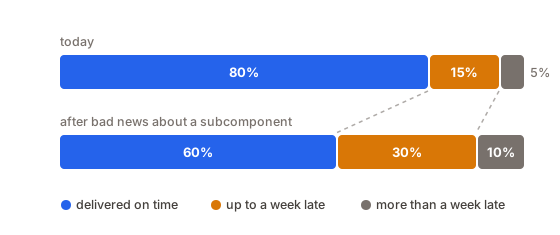
This makes updating easier: it feels like a small adjustment to a probability rather than a complete shift in worldview - like the bump from 80% down to 60% above, on learning bad news about a subcomponent.
Additionally, concrete beliefs can be used as action-guiding hypotheses. The landing-page belief above embeds a testable hypothesis: if prospective customers could see what their current solution is costing them, more would switch. That's something you can run the experiment on - say, put a cost calculator on the landing page and watch the conversion rate - and either result teaches you something that makes the product better.
Related concepts
This is part of my thinking tools series. Also consider:
- Adopt a scout mindset: the underlying disposition
- Be sceptical: the same standard, applied to claims you receive rather than ones you make - being disagreeable makes it easier for others to be sceptical of you.
- Overcommunicate: expressing your beliefs more leads to more opportunities to be corrected
- Think in public: a wide forum gets you the most corrections (though weight them by the expected quality of the critique - including who it's from).