Thinking tool: Create surface area for luck

There's a huge amount of randomness in the world. In practice, a lot of success comes from this randomness, or what people like to call "luck".
This might sound disheartening. Are you doomed to fail if you're just not a lucky person?
No! You can build your own luck.1There are of course reasonable limits to this! There can be things that are just fully outside of people's control, or people can get genuinely unlucky with the randomness.
And what I describe in this section takes time and energy: not everyone is in a situation where they can do this. For example, if you're working on minimum wage doing 2 full-time jobs to keep a family afloat, you probably won't have the time or energy to do much else.
In practice, most people I meet are not in this situation. 40% of Americans use TikTok, with the average 18-24 US adult user using it 52 minutes per day, i.e. ~27 hours/month. It's possible not all of this is a bad use of time, but I'd be surprised if most of this time wouldn't be better spent doing more active things in the world.
There are many ways to do this:Do more
 To find a 4-leaf clover, first spend some time in the clover fields!
In general, doing more - whether that's making things, writing things, volunteering, learning something, saying yes to things, going to events, talking with people - seems to correlate with getting opportunities. Cate Hall puts it well:
As an example from my own career, many people ask me how I got a job at Anthropic. I think a major factor2One distinguishing feature I’ve noticed among people who are unusually successful is that they just try a lot of stuff — socially, intellectually, professionally. It’s the rate of experimentation, the number of shots on goal, that provides the magic, not the percentage of successes, which might be very low at first.
It sounds stupidly simple, but it’s profound: the more times you interact with the outside world, the more chances you have to get lucky — to find the collaborators, friends, and projects that, together, provide the right soil for you to bloom in.
Of course, this is not the sole factor. I'm sure more "standard" factors played a major role in getting hired, e.g. being a competent software engineer.
But even these are supported by me doing many things! For example, I first got into programming because I wanted to make games for and with my friends.
is doing a lot of things that increased my luck. And even when you trace back "how did I get the opportunities to do those things", the answer is "by doing more things" again! For example:- I was referred by a friend, who knew me from volunteering on the tech side at Raise, an effective giving charity. And the reason I was pulled into Raise was because a different friend recommended me given we'd worked together on an iGEM competition project, where I led the software and hardware side.
- I had AI and AI safety expertise, primarily from working at BlueDot. I got the job at BlueDot after contracting part-time on the weekends and evenings (around a different job), because I thought it was impactful and fun - I didn't expect it to turn into a full-time job, but I just enjoyed it so much that it did. And going further back, I only discovered that part-time BlueDot opportunity because I said yes to going to an event in San Francisco that I was uncertain about, and applied for funding to go to this event even though I was nervous to.
- I worked with the UK Government on a secondment related to AI safety. I was only eligible for this secondment because I had volunteered to do some optional stuff while at Palantir, which led me to getting a particular credential useful for doing UK government work.
- A team considering me was building the Model Context Protocol (MCP), and thinking about agent safety. I had been fiddling around with uplifting myself and BlueDot with AI in the months prior, and had ended up building a couple popular open-source MCP servers. I'd also done some thinking and blogging about AI safety topics a year prior, that related to what the team was considering. And so, by accident, I had produced publicly verifiable proof that I was interested, engaged with, and experienced in the domain area that Anthropic happened to be hiring for in the UK at the time.
Of course, for each item here, there are probably a hundred things I did that just ended up not being relevant. But that's fine. I've enjoyed doing these other things, and think I'm generally more effective because of them.
And of course, this doesn't guarantee anything: there's always still a bit of randomness. But doing more things significantly pushed up my odds.
If you're unsure what to do:
- Start a blog! Writing isn't for everyone, but you might be underestimating how much you'd enjoy writing. My dread of writing was drilled into me at school, at university, and to some extent at work. This might be true for you too. But when I started writing about my interests, with no deadlines, and no word limits - I found I liked writing a lot more than expected!
- Nurture and follow your curiosity! It's amazing how little humanity knows about the world; it's often surprisingly easy to make intellectual progress, or invent something new. Even if it's empirically testing a weird recipe from Claude, or finding out what happens when you order special aeroplane meals. A good method here is learning by writing; pick a question you find interesting, and try to really get to the bottom of it.
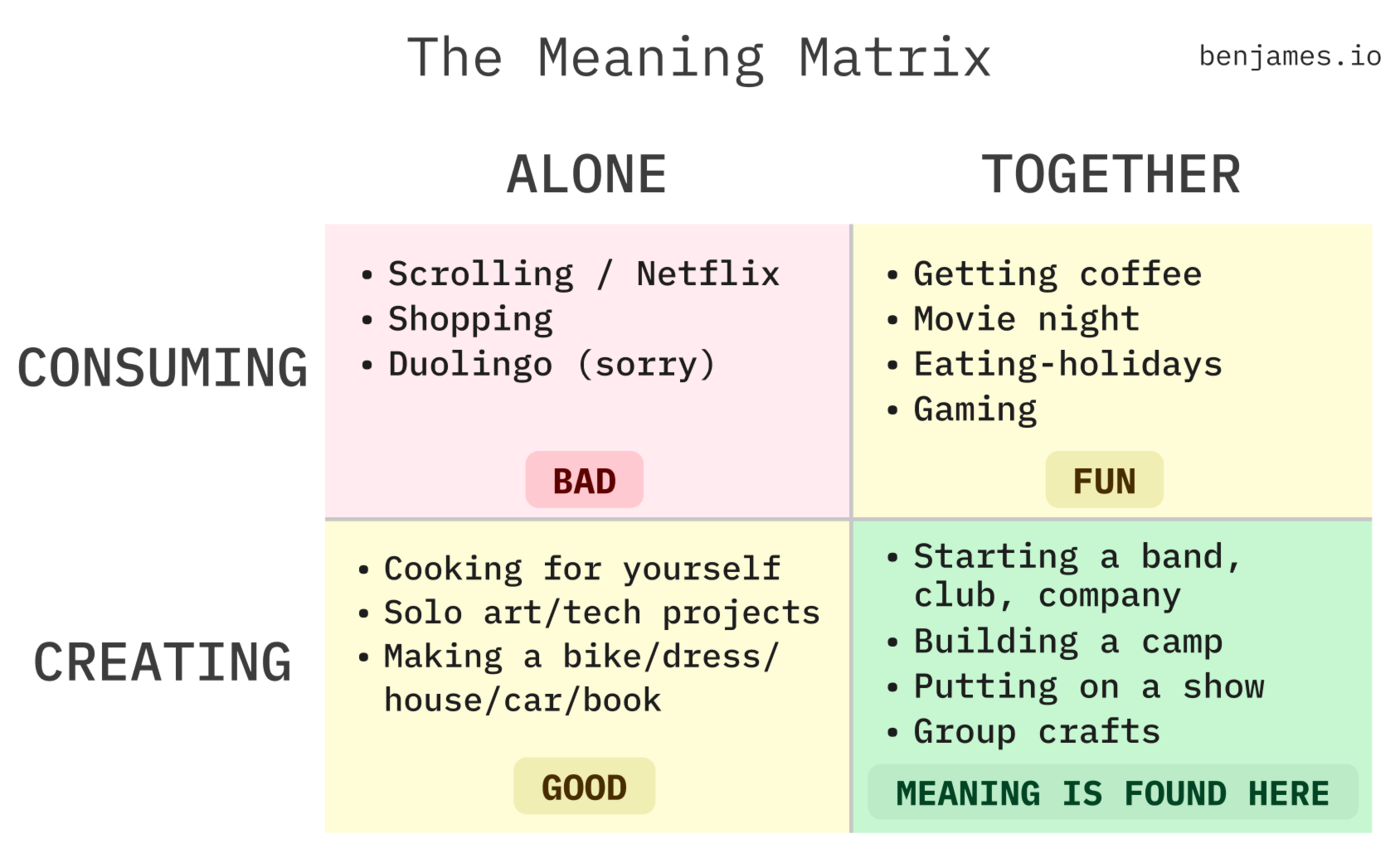
- Find a community with a goal, and help them with it. It's exciting to help achieve a shared goal, even if you only care about that goal a little. (Plus, caring about that goal will usually rub off on you as you work with the group anyway.) Creating together is particularly fun - Ben James's great diagram below is excellent, and he describes it well: "In quadrant four you are rolling with the gang. It’s Ocean’s Eleven. There is an aliveness and a thrill that can’t be found anywhere else. Quadrant four is where the greatest memories are made."
If you feel like you "vaguely should" be doing something, but not sure what: I highly recommend Nate Soares' posts Caring about something larger than yourself, "Should" considered harmful, and Not because you "should". These can help you refine what you care about, and build up your motivation to do a specific thing.
Getting started is genuinely the hardest part. It's a cliche, but it's probably a cliche for a good reason: it's true. This is for a few reasons3Because of these factors, the distribution for "a person who does things" seems surprisingly bimodal. I could be wrong on this, and it is just a hunch - but I've reviewed over 4,000 job applications to high-performance organisations like Anthropic and Palantir, and it often feels this way.
Being someone who "does things" is also really quite a rare trait, and also a trait that both I and many other hiring managers often take as a strong positive signal. So again, increasing your chance for "luck".
:- Brains find new things difficult and effortful (e.g. consider the first time you drove a car/rode a bike, vs now). Doing more is a new thing for most people. As you do more things, doing even more things will become easier.
- Doing more things strengthens your skills and network, which then helps you do more things! But at the start, these are both at their least developed.
- You might only have one or two ideas to start with - and maybe only be half-motivated by one. As you do more things, you'll often zoom into the detail of that area - and start to realise there are even more things to do, and that doing them really is important! "As our circle of knowledge expands, so does the circumference of darkness surrounding it." ~Unknown4
This might have been Albert Einstein, but also quite possibly not. Many quotes are attributed to Einstein that are probably not from him.
Again, really humanity knows surprisingly little. If you want to dig into this and do a proper quote investigation, let me know how it goes and I can update this article!
. Picking a creative project and then doing a huge amount of yak shaving to make it happen is also a good way to just cover a lot of ground.
The good news is, that means you should consider it a big achievement if you just take one step to doing more things. And one step - well, you can do that today!
Work in public
If you've done step one, and now you're doing more things, consider doing those things in public - publishing what you've done, whether that's on Twitter, Substack, or your personal website.
I've written this up fully in think in public. The short version: public output generates "passive opportunities" (people reach out to you - even for novice-level "learning exhaust", like the time a short Keycloak post earned me a $750 consulting offer), gives you a legible portfolio for the opportunities you pursue, boosts the reach of your ideas, and gets you free error-correction.
Prepare to seize windows of opportunity
 Spiders don't need to know exactly which insect is coming when to prepare a web.
The future is unpredictable. And there might not be excellent opportunities to be taken right now.
Instead of spinning your wheels on something mediocre, it might be better to prepare for future opportunities. To prepare:
- Be ready. Consider trends and their expected future impacts. How might you position yourself well if this turns out to be the case? "Skate to where the puck is going to be, not to where it has been." ~Wayne Gretzky, or maybe his father, Walter
- Keep your eyes open to opportunities. Make sure you don't put artificial restrictions on yourself that stop you considering opportunities. If you think you might not get something (be it a funding application, job application, startup success etc.), it's much preferable to have the world select you out of it than for you to have selected yourself out of it. Tip: apply to opportunities you think you'll get rejected by, to reframe rejection as a thing that happens when you're aiming high, rather than a negative sting or surprise. If you're not getting rejected at least some of the time, you're probably doing something wrong.
- Pounce on opportunities when they do actually become available!
Richard Rumelt's Good Strategy Bad Strategy describes Apple's Steve Jobs doing this:
In the summer of 1998, I got an opportunity to talk with Jobs again. I said, “Steve, this turnaround at Apple has been impressive. But everything we know about the PC business says that Apple cannot really push beyond a small niche position. The network effects are just too strong to upset the Wintel standard. So what are you trying to do in the longer term? What is the strategy?”
He did not attack my argument. He didn’t agree with it, either. He just smiled and said, “I am going to wait for the next big thing.”
Jobs did not enunciate some simple-minded growth or market share goal. He did not pretend that pushing on various levers would somehow magically restore Apple to market leadership in personal computers. Instead, he was actually focused on the sources of and barriers to success in his industry — recognizing the next window of opportunity, the next set of forces he could harness to his advantage, and then having the quickness and cleverness to pounce on it quickly like a perfect predator. There was no pretense that such windows opened every year or that one could force them open with incentives or management tricks. He knew how it worked. He had done it before with the Apple II and the Macintosh and then with Pixar. He had tried to force it with NeXT, and that had not gone well. It would be two years before he would make that leap again with the iPod and then online music. And, after that, with the iPhone.
Steve Jobs’s answer that day—“to wait for the next big thing”—is not a general formula for success. But it was a wise approach to Apple’s situation at that moment, in that industry, with so many new technologies seemingly just around the corner.
Related concepts
This is part of my thinking tools series.
Footnotes
-
There are of course reasonable limits to this! There can be things that are just fully outside of people's control, or people can get genuinely unlucky with the randomness.
And what I describe in this section takes time and energy: not everyone is in a situation where they can do this. For example, if you're working on minimum wage doing 2 full-time jobs to keep a family afloat, you probably won't have the time or energy to do much else.
In practice, most people I meet are not in this situation. 40% of Americans use TikTok, with the average 18-24 US adult user using it 52 minutes per day, i.e. ~27 hours/month. It's possible not all of this is a bad use of time, but I'd be surprised if most of this time wouldn't be better spent doing more active things in the world. ↩
-
Of course, this is not the sole factor. I'm sure more "standard" factors played a major role in getting hired, e.g. being a competent software engineer.
But even these are supported by me doing many things! For example, I first got into programming because I wanted to make games for and with my friends. ↩
-
Because of these factors, the distribution for "a person who does things" seems surprisingly bimodal. I could be wrong on this, and it is just a hunch - but I've reviewed over 4,000 job applications to high-performance organisations like Anthropic and Palantir, and it often feels this way.
Being someone who "does things" is also really quite a rare trait, and also a trait that both I and many other hiring managers often take as a strong positive signal. So again, increasing your chance for "luck". ↩
-
This might have been Albert Einstein, but also quite possibly not. Many quotes are attributed to Einstein that are probably not from him.
Again, really humanity knows surprisingly little. If you want to dig into this and do a proper quote investigation, let me know how it goes and I can update this article! ↩