Thinking tool: Diverge, then converge

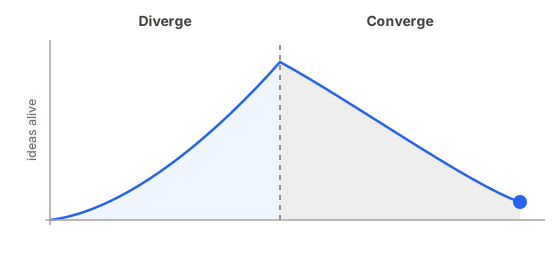
When you need to brainstorm and select a solution, there are exactly these two parts:
- Divergent thinking: brainstorming, creating, extending, developing
- Convergent thinking: selecting, choosing, eliminating, critiquing
This sounds obvious. What is perhaps less obvious is that these should be explicitly separated. That is:
- First, do a bunch of divergent thinking, throwing out lots of ideas, with criticism or objections explicitly disallowed. This can and should include wacky and wild ideas, or "reward hacks" against the stated goal.
- Then, once you are done generating ideas, vigorously eliminate the rubbish and select the gems.
Why might this work
Doing both divergent and convergent thinking at once genuinely seems to overwhelm our monkey brains. Even (or maybe especially) the smartest people I know get a sizeable performance boost from separating these out.
This might come from (handwavy speculation):
-
Separating generating ideas from critiquing them enables greater psychological safety, because:
-
Having a critique come back so quickly after you give the idea probably means your System 1 reacts strongly, and the pain of critique feels more visceral.
However, System 1 steeply discounts the future, so you can "trick" it by shifting the critique further away.
This allows your System 1 to be more collaborative and enjoy generating ideas, rather than fearing impending critique.
This is valuable because if you can freely put ideas out there, you can say lots and lots of (sometimes stupid) things. Of course later you're gonna have to select them down. But you can do that much better from a position of having too many ambitious ideas than too few; considering a wide range of ideas is important if you're going to find 100x opportunities.
-
Flipping between generation and critique means the people around you might just have attacked your ideas.
This might cause your monkey brain to subconsciously think you are in an adversarial situation with your peers, so you're less eager to build on their ideas or freely share your ideas.
-
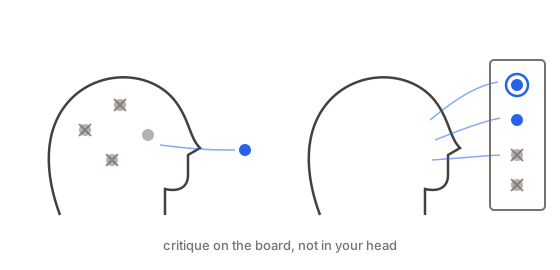
Distancing the people who have come up with the ideas from the ideas themselves, for example by noting all the ideas down on a big doc while brainstorming, means critique feels more like an attack on the idea, not the proposer. It's not perfect, but it does help.
-
-
Jumping between generation and critique might leave your brain half-"cached" in critique mode even when trying to generate ideas. This causes you to self-censor more, which limits the range of your ideas.
-
Relatedly, your brain "mode switches" less, which allows focusing solely on generating or selecting ideas. Just as context switching hinders human performance, I think mode shifting between divergent and convergent thinking causes a similar degradation.
-
It's just plain hard to avoid getting defensive when someone critiques your ideas. Anyone who has tried to hold a scout mindset while putting out ideas knows this. Not having to spend conscious effort averting a bias frees that capacity for better thinking.
In general though, I recommend you just run the experiment. Try it with your team, and see how it goes!
Related concepts
This is part of my thinking tools series. Also consider:
- Framestorming: diverge on the problem framing, not just on solutions
- Backchaining and forward chaining are both divergence techniques - use each deliberately