Thinking tool: Hunt for 100x opportunities

The efficient market hypothesis suggests prices already reflect all information, so there's no advantage to be had in picking what to do.
Luckily, most markets you can care about are incredibly inefficient. They don't meet the assumptions behind the hypothesis: they're small, information is imperfect, and actors are irrational.
For example:
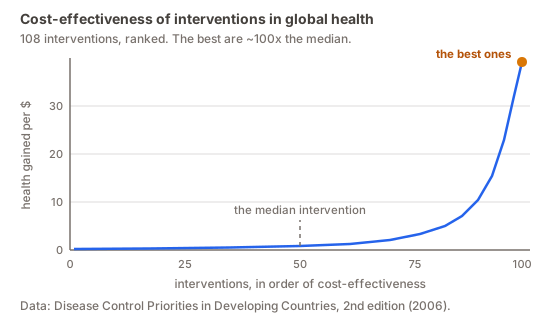
- In charity funding, the best charities are 100x more effective than average ones on common goals. But most people don't think about the effectiveness of their giving, and getting good information is hard.
- In a workplace, some ideas are 100x better to pursue than others. Few people are positioned to do them, principal-agent problems push actors towards irrationality, and even where they could be rational most people simply aren't.
So spend more time thinking about what you spend your time, money and energy on. There are two parts to this:
- Generating a lot of good options
- Selecting the best option
Most people do poorly on both, mainly because they never actively think about it. But you're reading this, so hopefully you are now!
Even people who do actively generate and select options often do it poorly. The nudges I give most often:
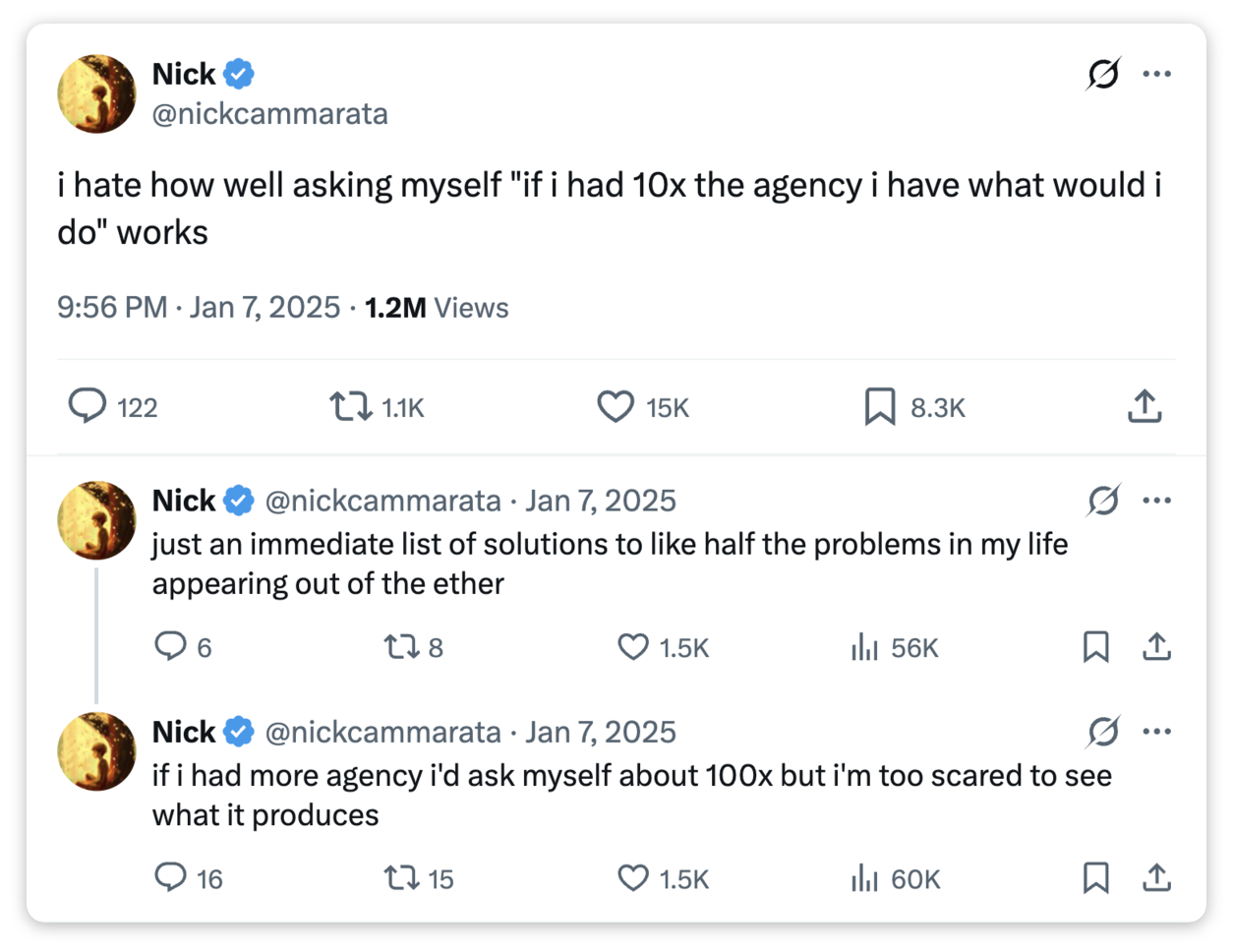
- Be far more ambitious and open minded when generating options. Most people's options are too "normal" and too boring. Consider:
- Generating options is a multiplayer activity! Ask close friends, advisors, or simulations of advisors.
- People stress about selecting between options. Rather than deliberating in your head, use made up numbers and reduce your uncertainty by measuring. And if you've done everything you can and it's still a toss up, drop the stress.
- Sometimes the real conflict isn't "what is better for my goals" but a values conflict: a happy personal life vs day-to-day enjoyment vs maximal impact. (These aren't always in conflict, but optimising hard for one usually costs the others.) No silver bullet here, but naming it as a trade-off, and accepting that trade-offs are okay, seems to help.
- People also assume their decision is "permanent".1
Under some worldviews this is more reasonable than it sounds: short AI timelines might suggest that if you're starting a new job now, it could be your last.
My guess is that it's probably not your last: as we get closer to the singularity, people will jump between a bunch of random jobs, doing ad hoc bits and filling in the gaps where AI systems just aren't very good. And I expect a very long tail of AI adoption, both into classic knowledge work and into the physical world via robotics.
Very few are: if it doesn't work out, you can usually quit and find something else. You might feel your time-sensitive opportunities make your situation unique - but think back to your last few decisions, which probably felt unique and time-sensitive too. If you quit after 8 weeks, you'd probably find interesting opportunities then as well.
Related concepts
This is part of my thinking tools series. Also consider:
- Backchaining often surfaces ambitious outlier options that forward chaining misses
- Diverge, then converge: generating and then selecting options is perfect for separating out divergent and convergent thinking
- Make decisions with made-up statistics can help you compare options spanning orders of magnitude
- Pick up the trillion-dollar bill: these opportunities do often exist in neglected areas
Footnotes
-
Under some worldviews this is more reasonable than it sounds: short AI timelines might suggest that if you're starting a new job now, it could be your last.
My guess is that it's probably not your last: as we get closer to the singularity, people will jump between a bunch of random jobs, doing ad hoc bits and filling in the gaps where AI systems just aren't very good. And I expect a very long tail of AI adoption, both into classic knowledge work and into the physical world via robotics. ↩