Thinking tool: Framestorming

Most brainstorming focuses on coming up with solutions to a challenge. You might brainstorm new strategies, new products, or new approaches.
But people rarely apply the same divergent thinking to understanding the problem area.
As put by Tina Seelig, Professor of the Practice in Stanford University’s Department of Management Science and Engineering, on episode 210 of the "How to be awesome at your job" podcast:
A company can get started, and say, “We’re going to cure cancer.” Well, that sounds like a really great idea.
But what if they asked a different question, “How do we prevent cancer?” [...] Or, “How do we detect cancer earlier?” or, “How do we allow people who have cancer to live better lives?” or, “How do we reduce the symptoms?” or, “How do we help people of different age groups?”
Each of these questions is critical to unlocking a different set of solutions. And so that’s where you come up with really innovative ideas.
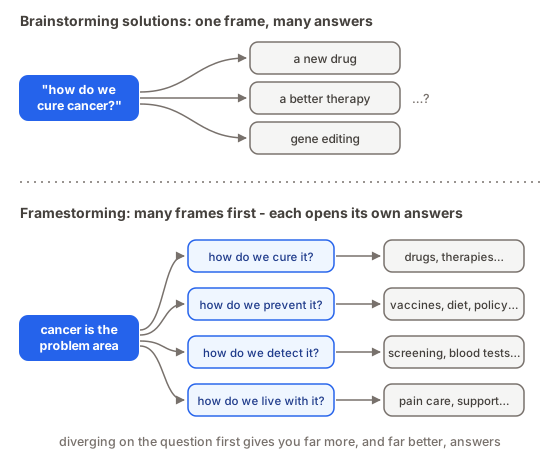
Brainstorming different framings of a problem, or perhaps problems within a problem area:
- can help avoid you being too zoomed in on a sub-problem (often without you consciously realising you're too zoomed in!)
- helps you generate more solutions as you explore different parts of the problem area
- acts as a forcing function to make sure you've truly understood your problem and the people it affects, making it more likely the solutions actually target the issue you care about
Related concepts
This is part of my thinking tools series. Also consider:
- Diverge, and then converge to make your framestorm more effective.
- Climb the user-contact ladder to understand the problem area better, and inspire more perspectives in your framestorming
- Finding problems, not applications for solutions tends to be a much more effective approach to product management; framestorming helps you stay in this headspace
- Be a new homunculus to avoid being attached to previous conceptions of the problem, to avoid overly constraining yourself when framestorming
- Adopt a scout mindset to properly understand the problem area
More on framestorming
- ModelThinkers: Framestorming
- How to be Awesome at Your Job: Episode 210: How to generate many creative ideas, with Tina Seelig