What is the Balanced Diet Meal (DBML) on Virgin Atlantic?

I ordered the 'Balanced diet' special meal option on Virgin Atlantic, described as:
This is a nutritionally balanced meal. It contains a balanced amount of fruits and vegetables; wholegrains or starches & healthy lean protein foods. Prepared with healthy plant oils, minimal sugar and with no added salt.
May be suitable for persons with diabetes or following a low fat, low salt or nutritionally balanced diet.
As with United's Low Calorie Meal, I couldn't find much online about what's actually in it. So here's the answer, from an overnight San Francisco to London flight. (Apologies for the purple: Virgin's mood lighting does no favours to food photography.)
Dinner

Main: Chicken with pretty dry asparagus, potatoes, a slice of unidentified vegetable (maybe squash?), a cherry tomato, and lemon slice.
Sides: a bland and very small salad with lemon slice (no dressing), crackers, a pot of cut strawberries, a bread roll, a blueberry muffin LÄRABAR, and Indulge Sour Cream Crunchy Corn Nibbles.
This tray was stickered DBML, the industry code for the diabetic meal.
Brunch
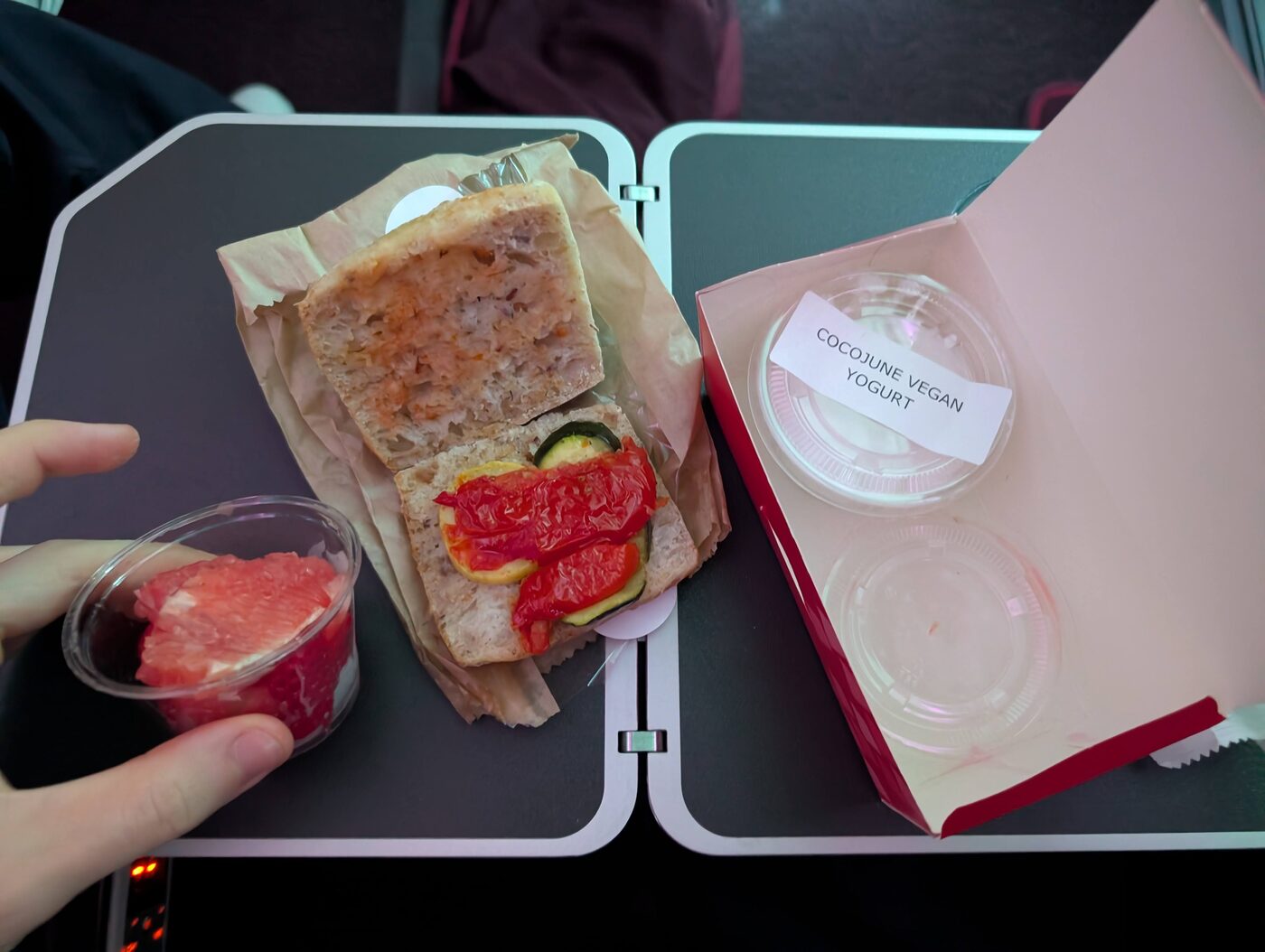
Main: Two slices of roasted courgette and two cherry tomatoes on some surprisingly soggy bread, a pot of grapefruit, and a Cocojune vegan coconut yoghurt.
Yes, coconut yoghurt again - it appears that despite its pretty awful1It's got a lot of bad: Coconut yoghurt is high in fat, and that fat is around 90% saturated. I don't know how much coconut yoghurt there was in this exact pot, but a small 113g pot of Cocojune packs 15g of saturated fat, or 75% of the FDA's 20g daily value. Meta-analyses of clinical trials find coconut fat raises LDL cholesterol compared to other plant oils: "Coconut oil consumption significantly increased LDL-cholesterol by 10.47 mg/dL (95% CI: 3.01, 17.94; I2 = 84%, N=16) and HDL-cholesterol by 4.00 mg/dL (95% CI: 2.26, 5.73; I2 = 72%, N=16) as compared with nontropical vegetable oils. These effects remained significant after excluding nonrandomized trials, or trials of poor quality (Jadad score <3)."
It's not got that much good: It lacks dairy yoghurt's main upside: 2g of protein per coconut yoghurt pot, versus about 11g in the same amount of Greek yoghurt. If restricted to vegan yoghurts, soy yoghurt would more than double the protein (4.5g vs 2g per 113g pot) and cut the saturated fat about 30-fold (0.45g vs 15g).
health profile, you can't escape it on 'healthy' airline meals.Footnotes
-
It's got a lot of bad: Coconut yoghurt is high in fat, and that fat is around 90% saturated. I don't know how much coconut yoghurt there was in this exact pot, but a small 113g pot of Cocojune packs 15g of saturated fat, or 75% of the FDA's 20g daily value. Meta-analyses of clinical trials find coconut fat raises LDL cholesterol compared to other plant oils: "Coconut oil consumption significantly increased LDL-cholesterol by 10.47 mg/dL (95% CI: 3.01, 17.94; I2 = 84%, N=16) and HDL-cholesterol by 4.00 mg/dL (95% CI: 2.26, 5.73; I2 = 72%, N=16) as compared with nontropical vegetable oils. These effects remained significant after excluding nonrandomized trials, or trials of poor quality (Jadad score <3)."
It's not got that much good: It lacks dairy yoghurt's main upside: 2g of protein per coconut yoghurt pot, versus about 11g in the same amount of Greek yoghurt. If restricted to vegan yoghurts, soy yoghurt would more than double the protein (4.5g vs 2g per 113g pot) and cut the saturated fat about 30-fold (0.45g vs 15g). ↩