Thinking tool: Build systems, not willpower

Every year, millions of people earnestly set New Year's resolutions. But fewer than half make it to six months. I imagine these failed resolutions might look like:
You want to go to the gym more. Willpower gets you through for one or two weeks, but then something would come up: you'd get busy or be tired this week... but not to worry, you'll go back again twice as hard next week. Then next week rolls around, and you have another excuse, and your gym habit kind of fizzles out. 3 months later someone asks you how your resolution is going and you sheepishly answer it fell apart, and feel guilty.
What sets apart the people who excel at their resolutions is building systems that make them easier to achieve. And by systems here, I really mean collections of actions that shift the incentives.
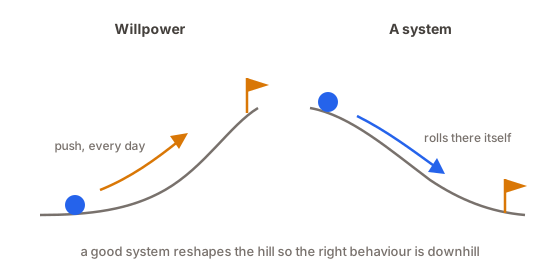
These systems:
-
Increase value of success: Get a tracker to see your progress improving over time (Ideally, you actually want this to be tracking the thing you are really motivated by, not just some arbitrary number going up. I mean, humans can be tricked into getting excited about basically any number going up (see: clicker games, Duolingo streaks, quantitative finance). But it'll be an even greater boost if this is truly connected to your higher-level goal.)
-
Increase cost of failure: Find a gym buddy and agree a regular time to hold you accountable. (A common technique is focusing on guilt, although I don't think this is a good idea, or "burn the boats"-style commitments).
-
Make it easy: Pre-pack a gym bag always ready to go. Hook gym going onto an existing habit, or set up something you see regularly to remind you.
-
Meta: Empathise with future you, and figure out what other interventions will keep them motivated, as well as how to mitigate risks that would knock you off track (e.g. losing the habit when on a business trip)
Zooming out further, consider framestorming and ensure you understand the problem you're trying to solve. When you say you want to go to the gym more, is this because you want to be healthier, lose weight, gain muscle, or finally justify the membership you've been paying for since January? Maybe there are more effective ways to achieve your goals, e.g. to lose weight, you should probably first focus on your diet.
(All that said, don't use not having a formal system as an excuse for not doing the actual thing! Sometimes it is sensible just to run down to the gym, do it once, and bolt the system on later to make sure you maintain it.)
Other benefits of systems
Boosting personal motivation is obviously useful for New Year's resolutions. But building systems is pretty generically useful:
-
Boosting safety outcomes in surgeries with safety checklists. This massively reduced complications and deaths even for routine operations by experienced teams: in the WHO trial, major complications fell by over a third, and deaths nearly halved.
Similarly a short central-line checklist took a common class of ICU infections across Michigan down to a median rate of zero within months.
-
Aviation safety is built on systems, not hero pilots. The pre-flight checklist and crew resource management training exists because crews following procedures beat individual brilliance.
And there are a bunch of other benefits of systematizing things:
- It's much easier to analyse the system to identify constraints
- Once you can measure end-to-end system latency, it becomes easier to shorten cycle times and iterate faster
- Once you have a system you can start to collect feedback about it and improve it over time
- Formal systems are much easier to describe to AI tools, making you more AI-legible
Related concepts
This is part of my thinking tools series. Also consider:
- Build feedback loops: a feedback loop you can trust is itself a system - bake it in so it runs without willpower
- Optimise only the constraint: you can only find the constraint in something systematised enough to measure