Empathy: an absurdly underrated career superpower

It's weird that empathy is so rarely prioritised as a key career skill. Maybe because it's imagined as purely about emotions and touchy-feelies, irrelevant to people's idea of formal work training. But this couldn't be farther from the truth.
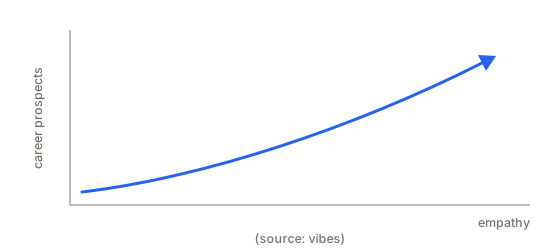
Even as an individual contributor, empathy can land you better jobs, strengthen your ideas, and help you build better products.
What is empathy?
Per Wikipedia:
Empathy is generally described as the ability to perceive another person's perspective, to understand, feel, and possibly share and respond to their experience.
Basically, empathy is when you understand someone else's perspective.
Once you understand someone's perspective, it's easier to predict what they might do next or how they might react to your actions. And once you have prediction over actions, you can optimise.
Why is empathy useful?
Examples:
- Applying to a job: thinking things through from the hiring manager's perspective lets you write a much better CV, cover letter and application answers. You'll prepare and perform better in interviews. It's kind of incredible how much this can set you apart, and (being a hiring manager and admissions lead myself) how rarely anyone does it.
- Building a better product: empathising with your users makes you far better at designing products they actually like. You can take this further with empathetic role-playing as a way to climb the user contact ladder.
- Teaching, mentoring or communicating: figuring out where precisely someone is confused or stuck makes good communication easy. Going further, predicting how different frames might affect people's mindsets can help keep conversations productive, for example, helping people stay in the scout mindset. And understanding other people's beliefs makes it much more likely you'll find the crux that changes their mind - or yours.
- Learning: On the flip side, following other people's perspectives can make you a better learner: you can compute the diff between the teacher's mental state and yours, to figure out where you're not following and need to ask follow-ups. Empathy also makes it easier to be more effectively disagreeable: you can write up your thoughts thinking about "if you were in the reader's position, what would make it easy to critique?"
- Self improvement: Being able to recursively self improve is extremely valuable. It sounds weird, but I think empathising with other people extends to empathising with your subconscious and future versions of yourself. For example, let's say you want to go to the gym more. If you can accurately empathise with future you, and predict that you'll use the excuse of the gym being too far away, you can make success more likely by aggressively finding a nearby gym, or buying gym equipment for the home.
- General advice: Being able to meet with advisors in your head is a surprisingly useful way to be more effective, and ensure you cover all the obvious things.
Empathy is a learnable skill
Sometimes when I get people hyped about empathy with the above, they agree it's useful, but get disheartened because they think they don't have the skill.
But empathy is a learnable skill! It even often has quite good feedback loops.
I'm not certain what the best way to boost empathy is; I'd be keen for someone to figure this out! But I've seen people get better at it with practice.
Some initial ideas:
- Predict what someone believes or is thinking, then go and test whether your predictions are true. Hopefully you have friends or colleagues you can practise this with. Failing that, you can at least predict what future you will think or feel about something.
- An example: next time you share something with your friends or colleagues, try and predict their reactions and comments.
- Some part of the skill is having quick intuitions for what others might think or feel. I think this just comes from explicitly practising a lot. In some sense, all this explicit practice of thinking hard about who the stakeholders are and what they'll be thinking is "test-time compute plus distillation", applied to humans.
- Watch movies and TV shows. Explicitly think through non-main-characters' thoughts and feelings. Compare notes with friends or AI systems like Claude.
With great power comes great responsibility
Like most skills that make you more effective, empathy can be used for bad.
Empathy maybe feels particularly bad because it pattern matches to "thinking about how you frame things to affect what people think" → "bad politics".
But I think the majority of use cases are strictly good, and aren't deceptive. For example, if someone is communicating an idea to me, I want them to think about the most effective way to get the idea into my head, or which bits I'll be most interested in, and highlight those.
Don't use empathy deceptively, e.g. for downplaying valid concerns, or encouraging people to do things against their own interests. And don't use it as an excuse for not being transparent and honest.