Thinking tool: Defend slack

When planning capacity: you shouldn't usually operate at maximum capacity. Capacity could be time, money, people, social capital or any other constraint.
Having slack is what lets you absorb disruption, seize opportunities, and maintain executive functioning.
This doesn't mean not working hard. In fact, you can work extremely hard, and still have slack: you can create slack either by spending less capacity, or figuring out how you can add more capacity. Someone who works 100-hour weeks with the capacity to work 110 has slack, someone who works 10 hours with capacity to work 10 doesn't.
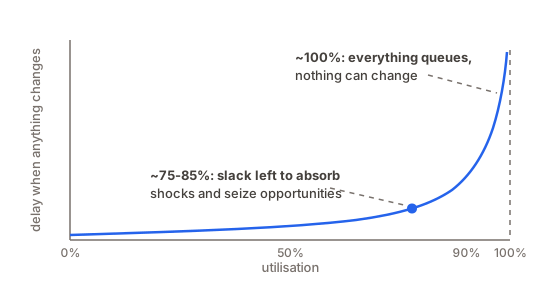
This is not just "be nice to yourself" - it also makes you more productive. Queueing theory and empirical experiments show that with variable-sized tasks at high utilisation, the time it takes you to react to things shoots way up.1For the quantitative version, see queueing theory: with unpredictable arrivals, waiting time grows roughly in proportion to 1/(1-utilisation). At 90% busy, jobs wait about nine times as long as they take to do; at 99%, ninety-nine times. (People argue about the exact right hospital occupancy - it depends on ward size and variance - but nobody argues it's 100%.)
For example, hospitals deliberately keep ~15% of beds empty, because above ~85% occupancy, emergency admissions start hitting dangerous queues.
Even ignoring the other direct benefits, adding slack to your plans helps combat planning fallacy, where people expect things to go better than they actually will, and also underestimate the time needed to do tasks.
Related concepts
This is part of my thinking tools series. Also consider:
- Prepare to seize windows of opportunity: slack is what lets you actually pounce when the window opens
- Accept redundancy: redundancy can often buy slack, as it removes constraints
- Optimise only the constraint: slack matters most in your bottlenecked resource - that's the one where queueing bites
Footnotes
-
For the quantitative version, see queueing theory: with unpredictable arrivals, waiting time grows roughly in proportion to
1/(1-utilisation). At 90% busy, jobs wait about nine times as long as they take to do; at 99%, ninety-nine times. (People argue about the exact right hospital occupancy - it depends on ward size and variance - but nobody argues it's 100%.) ↩