Why I disagree with Yann LeCun on whether LLMs could scale to AGI

Can today's large language models scale to AGI? Meta's Chief AI scientist, Yann LeCun, says no. I think his arguments are wrong.
LeCun's case boils down to four claims (full summary here):
- Machine learning is sample inefficient
- LLMs are trained on text, not videos, so don't have enough data
- Predicting the next token means there is an exponentially small chance for models to be right
- LLMs don't have system 2 ('deep') thinking
Let's go through each of these...
Machine learning is sample inefficient
LeCun argues models need many more examples than humans to learn things. However:
- In-context learning (a fancy name for 'prompting a trained AI with some examples') shows models can learn new tasks from a handful of examples.
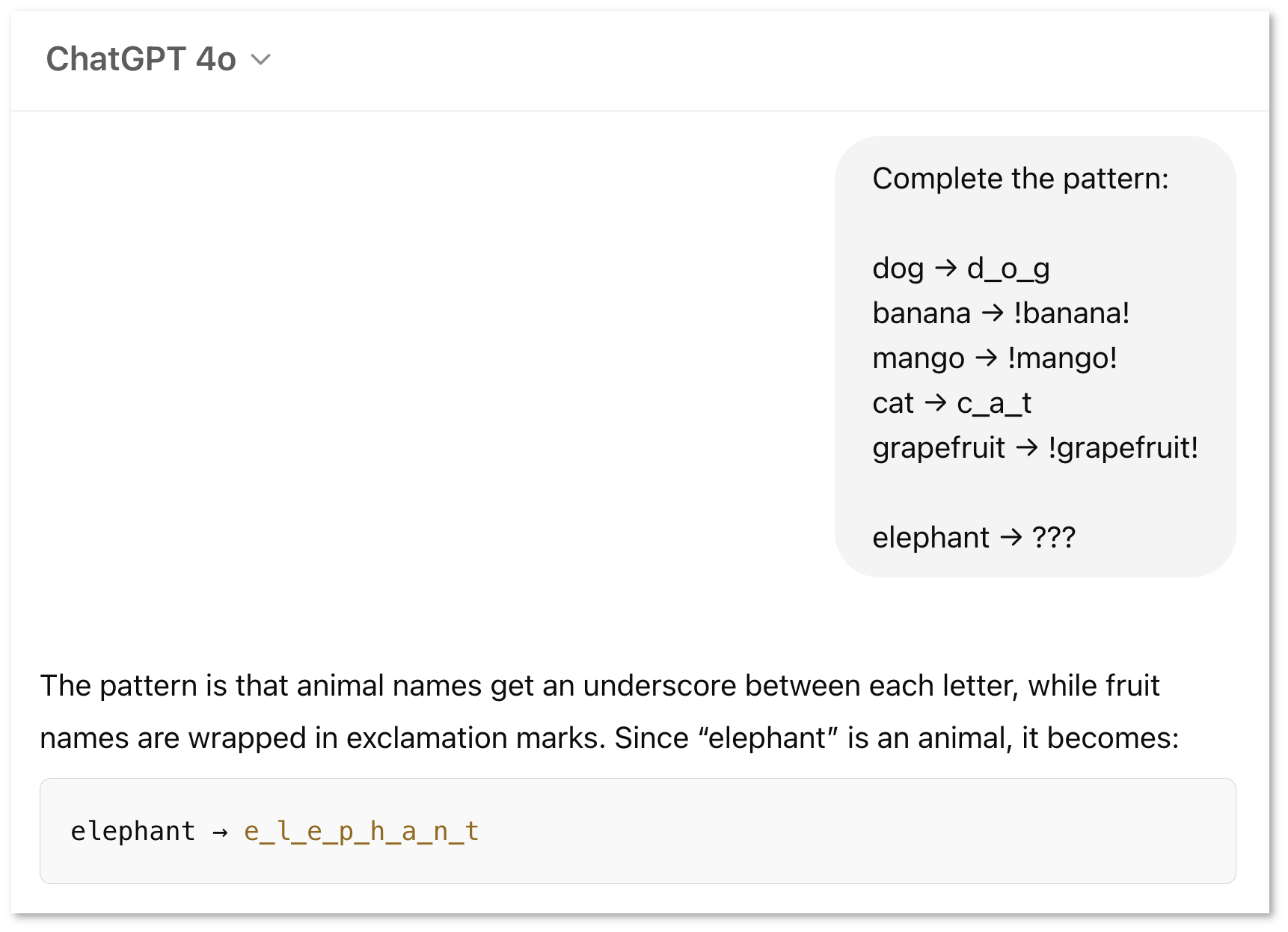
- I think this is a fair comparison, as human learning isn't starting from scratch either. We have priors baked in over millions of years of evolution (which might be more akin to LLM pre-training, which is more sample inefficient).
- Techniques to overcome sample inefficiency are evolving rapidly, particularly synthetic data generation leveraging this in-context learning. Teacher models like Meta's own Llama 4 Behemoth can create many more training samples.
- The volume of data available for pre-training dwarfs what any human could process in a lifetime: 500 hours of content is uploaded to YouTube every minute. Even with inefficient learning algorithms, models can compensate through scale.
This doesn't seem like a fundamental barrier to scaling - just an engineering challenge already being addressed.
LLMs are trained on text, not videos, so don't have enough data
LeCun claims text-based training means AI models will process less data than a human does when learning, because video (like our eyes see) contains so much more data. (E.g. 1 minute of video is about 10MB; the complete works of Shakespeare are ~5MB.)
However, all frontier LLMs are being trained on videos now! This includes Meta's own Llama 4 models, which LeCun would have been aware of when making this point.
Even setting that aside, this point conflates data size with information content. Text is extraordinarily information-dense: the complete works of Shakespeare convey more than half a TikTok video, despite being about the same data size.
Aren't large language models text-only by definition?
Random nerdy fact: A "language" in computer science theory is sometimes taken to mean anything that can be modelled as a sequence of symbols. So arguably they are processing a language - that of tokens (which can come from text, video, audio etc.). (I couldn't find whether the etymology of 'language model' comes from this though).
Tokens can represent text, images, audio, or any data.What most people call LLMs today (OpenAI's ChatGPT, Anthropic's Claude, Google Deepmind's Gemini, and Meta's Llama models) are all multimodal. Meta calls their own Llama 4 multimodal model a large language model:
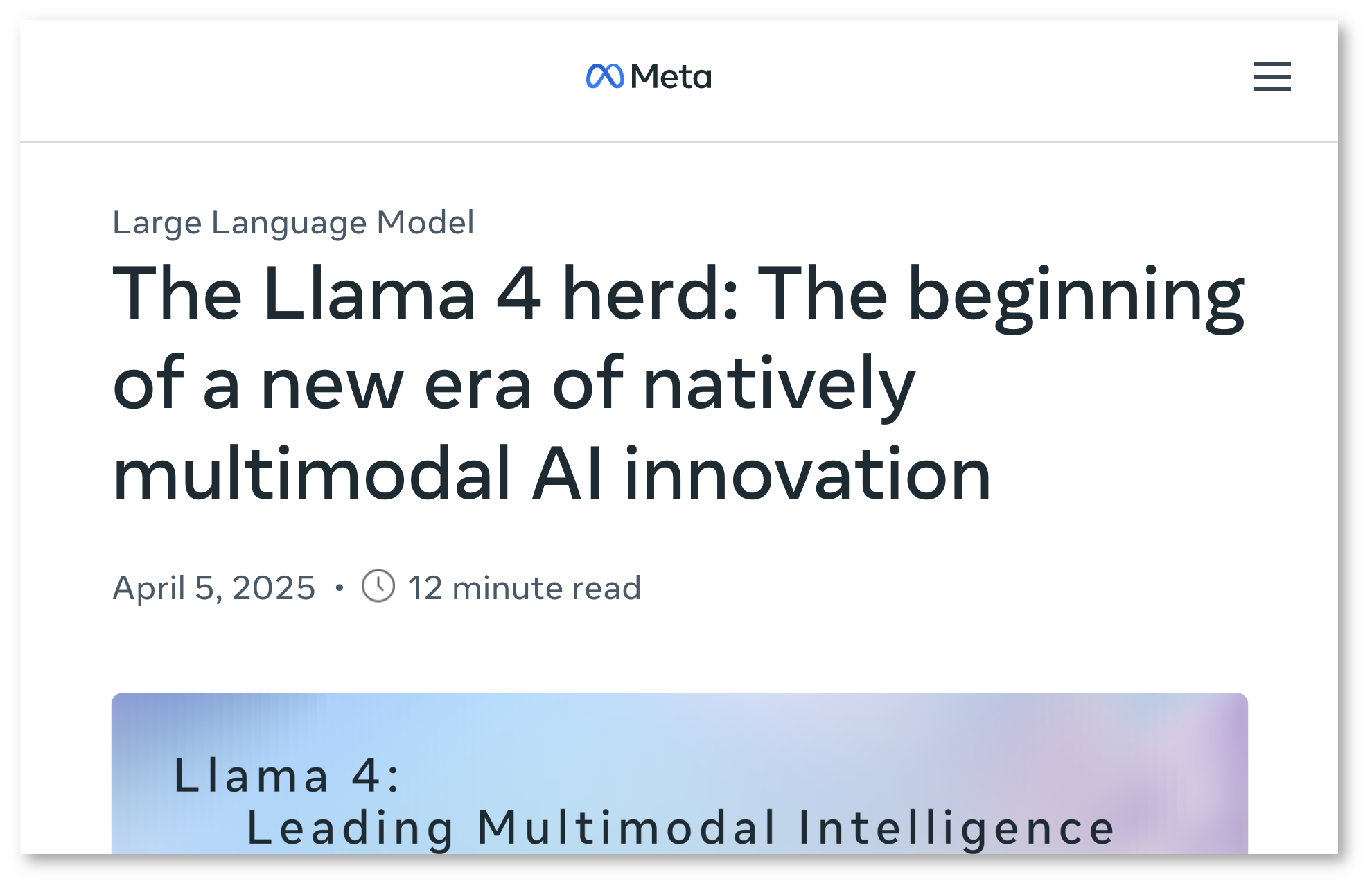
Insisting a 'language model' must be text-only becomes an argument over semantics. If someone goes down that route, my claim becomes 'current frontier models like the ones listed above do not have this limitation, whatever you want to call them'.
Predicting the next token means there is an exponentially small chance for models to be right
When training large language models, a loss function tells the model how correct it is. In pre-training, correct = predicting internet text exactly word-for-word. If the text online is 'The cat sat on the mat', the model has to predict exactly this to get the best score.
LeCun claims models will always be wrong, because there are so many chances to slip up.
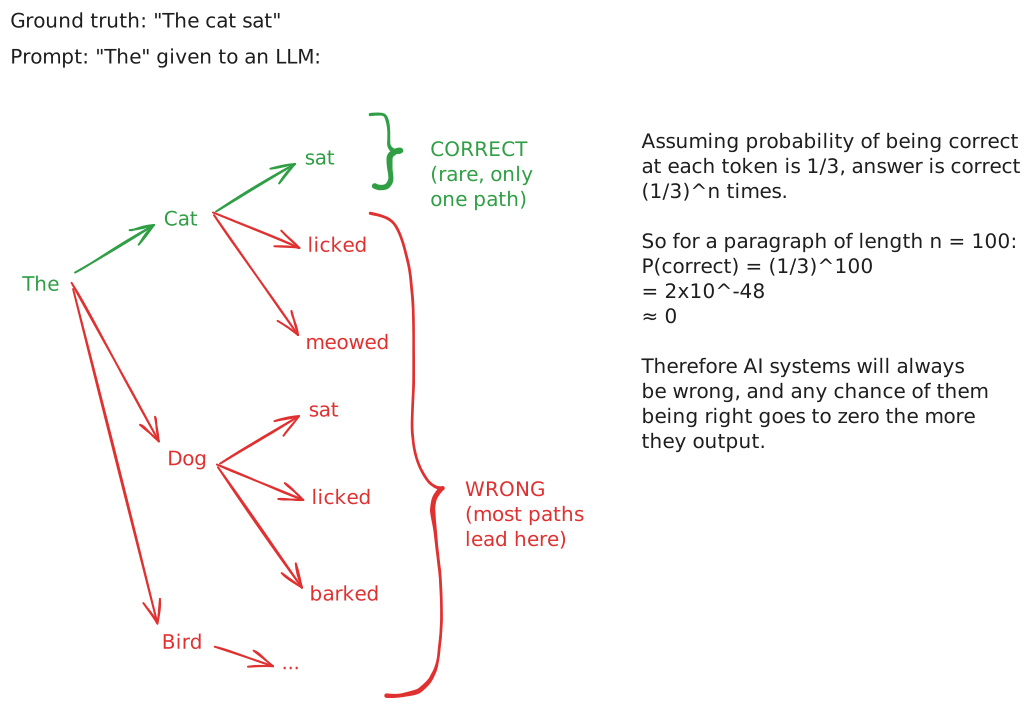
However, reproducing existing text isn't our goal for AGI. All of these get to the same overall answer:
- A cat sat on the mat
- A cat was sitting on the mat
- On the mat, sat a cat
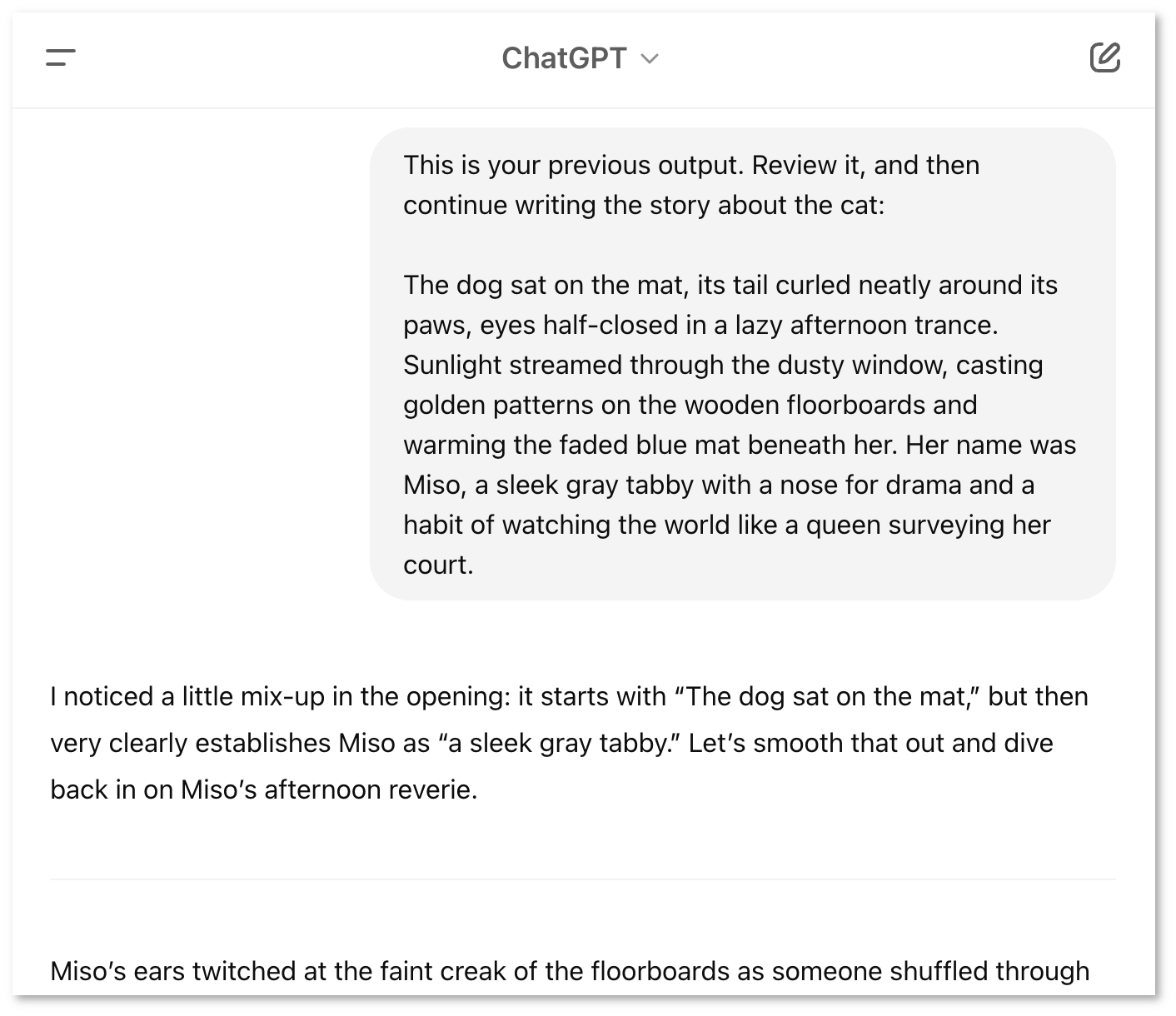
- A dog - oh no wait sorry I mean a cat - sat on the mat
There are many routes to the destination, not one. And with self-correction, models can often get themselves back on track.
LLMs don't have system 2 ('deep') thinking
There is genuine uncertainty about whether this (or something like it) could cause AI progress to plateau. But it doesn't seem to imply that LLMs are 'doomed' and can't scale to AGI.
Scaling alone has exceeded most previous bearish predictions about the kinds of reasoning LLMs can do. And it's not clear system 2 thinking is a 'real' barrier, any more than the previous supposed barriers were.
Some techniques already let models 'think harder' on particular things: chain-of-thought reasoning seems to demonstrate system 2-like capabilities.
What I believe on LLMs scaling to AGI
I believe the LLM architecture could scale to AGI with enough compute and data along the current trajectory (e.g. multimodal LLMs, tool use, agent loops, chain-of-thought inference-time scaling, reinforcement learning from self-play environments).
However, I agree with LeCun that scaling LLMs is unlikely to be the optimal path to safe AGI. It's plausible we'll discover better architectures before AGI, which might speed up progress even more.
To me, this means scaling LLMs sets an upper bound on how hard AGI is to achieve - all the more reason the world should be better prepared for such an important technology.
Footnotes
-
Random nerdy fact: A "language" in computer science theory is sometimes taken to mean anything that can be modelled as a sequence of symbols. So arguably they are processing a language - that of tokens (which can come from text, video, audio etc.). (I couldn't find whether the etymology of 'language model' comes from this though). ↩