Thinking tool: Overcorrect, then settle

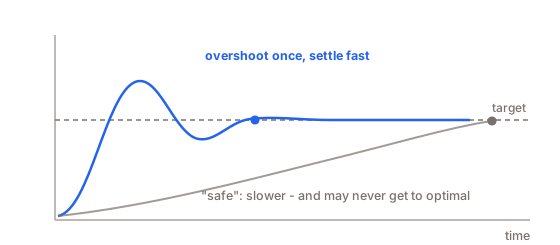
When acting on feedback to change a behaviour: overcorrect, then find the middle.
This is because it's difficult to tell whether you've corrected enough, and human biases tend to leave us undercorrected.
Deliberately overshooting will usually get you a more obvious signal about how changing your behaviour affects the outcome. Then you can balance the two feedback loops and iterate with short cycle time to find the optimal point.
Whereas if you undershoot you might just not get substantially different feedback, so you make slower progress. And it's usually easier for you to fall into old habits.
Related concepts
This is part of my thinking tools series. Also consider:
- More dakka: overcorrecting is more dakka applied to feedback
- Run the experiment: the overshoot is the experiment - it's how you find where the line actually is