Suddenly becoming vegetarian, and maybe even vegan???
I've switched from occasionally eating meat to being vegetarian, and soon maybe vegan.1
There's a fair bit of debate over what exactly vegetarianism and veganism is. Online communities around them, especially veganism, can sadly appear unwelcoming because of this strict gatekeeping of definition.
Because of my animal welfare motivations for vegetarianism or veganism, while also trying to balance having positive impact in other parts of my life, the very nitpicky definition I'm using is:
Avoiding personally-attributable actions that non-negligibly counterfactually incentivize net animal suffering and slaughter relative to the benefit it brings me, to the extent reasonable while living a "normalish" life
This would make the following actions allowable:
- Buying fruit and veg, including that which has used reasonable quantities of insecticide or factory-farmed animal manure (where that farm treats manure as a near-zero-value by-product)
- Buying eggs, dairy products, and honey produced in standard commercial ways
- Buying oysters and mussels
- Putting down 'vegetarian' or 'vegan' as my dietary requirements for an event
- Eating eggs given to me as a meal, where I expect refusing it would send some form of demand signal to avoid this in future
- Eating a plant-based burger with incidental contamination from a meat burger when it touched on the grill (but not intentional contamination)
- Eating meat that would otherwise be disposed of/unused, where this does not create any demand for more meat, for example roadkill or a fully-counterfactual food waste collection through something like Olio
- Accept treatment from an animal-flesh-derived live-saving drug, at reasonable ratios
- Take paracetamol for a headache, when it has 1/8 millionth of a cow's tallow (which is largely just a cow slaughter by-product)
- Killing a parasitic insect like a tick, parasitic worm or mosquito
- Going for a walk to the shops, and accidentally stepping on an insects on the way
- Causing animals who are likely to have net-negative or neutral lives not to be born, e.g. by covering a water source to prevent mosquitoes from reproducing
And the following disallowable:
- Buying meat or leather products
- Not putting down any dietary requirement for an event, where I expect putting down a requirement would change upstream food demand slightly
- Eating meat given to me as a meal, where I expect refusing it would send some form of demand signal to avoid this in future
I have tried to pick several borderline cases to sharpen the boundary of the definition; I appreciate reasonable people will disagree about which side of the line these fall on! Although in practice, most of the impact will likely happen quite far away from the boundary.
I also recognize that "relative to the benefit it brings me" is in some ways quite selfish, and "to the extent reasonable" is quite vague, but I think together they still results in a large behaviour shift from my previous position and in line with what most people would consider vegetarian. And having some reasonable flexibility will make me more likely to stick with this: dieting research finds flexible rules beat rigid all-or-nothing rules for actually sticking to a diet, and with 84% of people who try vegetarianism or veganism eventually lapsing, sticking with it is where the long-term animal welfare impact is.
I think "and slaughter" is a bit arbitrary, and especially eggs or honey feel odd to allow (as others have noticed). This is why I think I'm likely to go vegan, or at least exclude these two.
Almonds and avocadoes seem borderline to me; the common argument is that almost all standard production of them requires farmed bees which suffer (or don't?). I feel I just don't know enough. Luckily I'm not a big almond consumer anyways.
And to consider myself vegan:
Same as above, but drop "and slaughter"
Which would move the following from the 'allowable' to 'disallowable' lists:
- Buying eggs, dairy products, and honey produced in standard commercial ways
- Putting down 'vegetarian' as my dietary requirements for an event
- Eating eggs given to me as a meal, where I expect refusing it would send some form of demand signal to avoid this in future
(I'd still buy oysters and mussels, eat roadkill/to-be-disposed meat, kill parasites, accept a life-saving drug, take paracetamol, and be fine with incidental traces)
I thought it'd be helpful to write down what caused this to 'click' in me, to get my own thoughts straight and perhaps for people working to convince others to take a similar step. I'll probably make a less rambly version of the argument that convinced me in future; this post is more a reflection on my path.
Background
I grew up in a house that ate meat fairly regularly. I disliked most meats, disliked eggs, and really disliked milk (none of this for ethical reasons, just being a picky eater). I tried to avoid them - e.g. eating dry bowls of cereal to avoid having milk. I'd also load up more on the vegetables (thanks mum for cooking extra for me!), although often only as sides. We did occasionally have tofu, which was probably a fair bit of my protein - although in hindsight, I might have been fairly protein deficient?
Later at school and university, I went through vegetarian phases for somewhat vague climate/environmental reasons... and also just being a bit of a rubbish cook who didn't trust himself to cook meat safely! Plus I didn't feel like I was giving that much up - cooking most meals myself meant options were pretty good, I still didn't like meat that much, and most places you go to as a uni student have decent veg options.
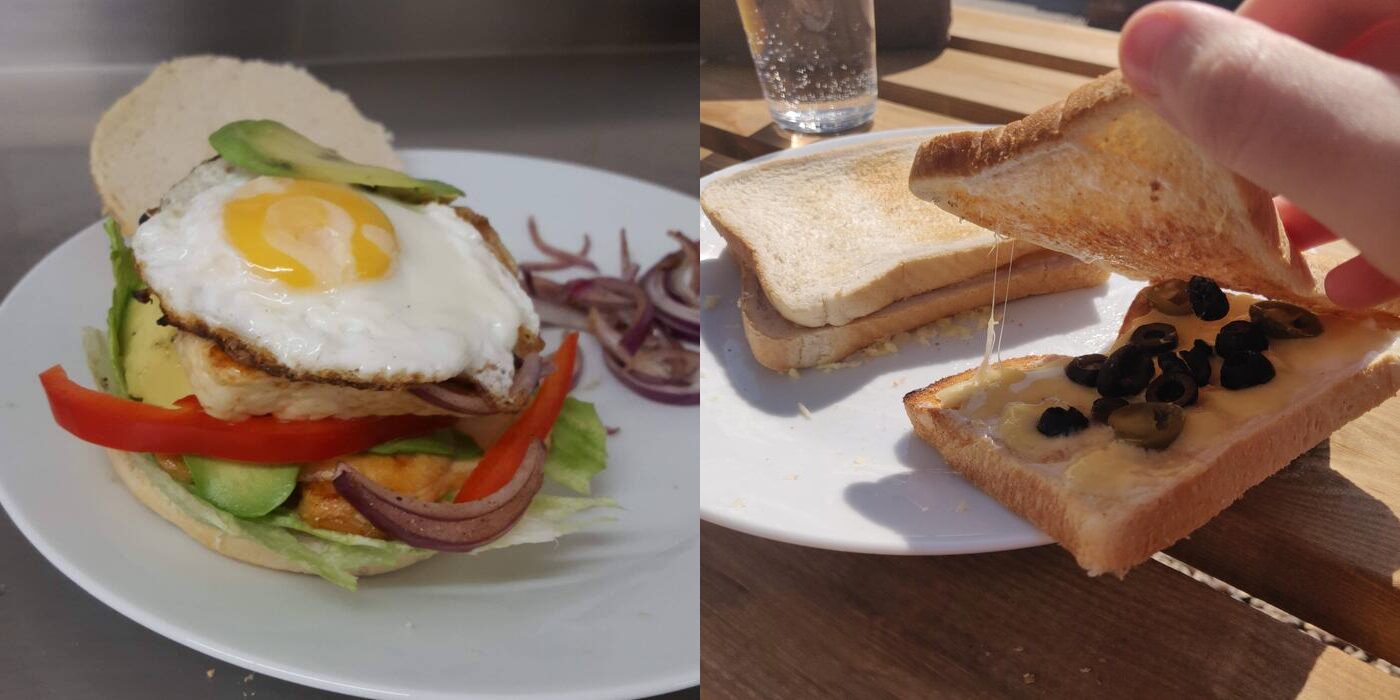
Left: A halloumi burger I cooked, and was proud enough of to take a photo. Right: Most uni food I made myself was pretty bad, I guess this was err.. cheesy olive toast?
I'd occasionally lapse from my vegetarianism mainly because I didn't "feel" it very viscerally - reducing carbon emissions felt abstract. I was also doing it on my own, and became disillusioned with the climate impact of diet relative to other climate work. I'm not sure why I didn't consider the general animal welfare implications very deeply, or experiment with veganism much.
When I started working, I ate a lot more meat. Work canteens and work-arranged food deliveries seemed to have a much greater delta between the meat and vegetarian options, and combined with the waning enthusiasm for environmental vegetarianism the habit slipped. Some jobs (like being an FDE) also involved a lot more travel, which in some countries made keeping to a vegetarian diet hard. Even just eating out at UK restaurants can be hard.2I'm confused why restaurant veggie/vegan food is so much worse than the meat option. When I cook myself, vegan food is 95%+ as nice if not nicer than meat dishes I cook. But most restaurants provide pretty bad vegan options, and even if they succeed at making something that tastes good it's usually terrible in terms of nutrition.
If anyone knows a restaurant that has affordable, low-calorie high-protein, vegan meals in London please tell me. My current list is:
- [this page is intentionally left blank]
(Govinda's is affordable but is pretty unhealthy: very high in oil and low in protein, it has a poor food hygiene rating, and generally poor/confusing food labelling - e.g. they claim everything is "100% vegan-friendly" but then sell paneer cheese. It might be possible to use their À La Carte menu to stack up on dahl and beans enough to mitigate this; I think someone could argue me into this moving to the list. I do like going to Govinda's.
George Farha Cafe offers a very affordable Tofu & Rice, but it's very carb and oil heavy.
Indian YMCA is affordable but their vegan option is also very high in oil and low in protein. It might be possible to stack up on dahl if you ask the servers nicely though.
Indian Veg on Chapel Market is borderline on this list. Given it's a buffet, and you can stack hard on the protein heavy hitters e.g. the vegan lentil or chickpea dahls. It's £14.95, which is by no means expensive, especially if you tackle it like a buffet and go up for many plates of food. But it doesn't really hit the same price point as say Pret.
Pret, speaking of, is affordable and has some vegan options, but again none are very high protein. The highest protein vegan main is currently the Humous & Chipotle Wrap, which only offers a paltry 12g of protein for 394 kcal.
Supermarkets are probably the best option for vegan food, and rawdogging a block of tofu might be The Way (okay maybe not... but it might be better than some options). Over the last few months I've actually gone to Lidl for most of my office lunches and dinners. I buy a bunch of veg, plus some protein topper, and prepare myself a salad.)
So without really thinking very hard about the impact, I defaulted to the tastier-looking meat option. At Palantir, and especially at BlueDot, I worked closely with some vegan colleagues who introed me to great vegan food places in London which I enjoyed and go back to often, but still nothing really 'clicked' in me. Perhaps they assumed I'd already been briefed with high-quality animal welfare arguments, when I hadn't.In December 2025, I took a couple weeks off work. I asked Claude how I might spend some of that time, and it suggested getting my non-work life a bit more together: eating better, developing an exercise routine, and arranging a bunch of social events with friends. Following Claude's instructions has improved my life a lot, although I admit it sounds crazy.
The eating part is most relevant as I've been trying to have more protein. Again without thinking hard I leant into chicken, yoghurts, cheese, and whey protein - all animal products.
It sounds incredibly stupid in hindsight,3This is a sign of learning at least I guess!
but throughout I basically didn't think hard about "where does this meat come from and what was the life of that animal like". Subconsciously, I imagined more "Shaun the Sheep"-style farms, without realising the reality for most animals is intensive and cruel factory farming. Growing up in Central London and not knowing anyone involved in factory farming, or ever really being taught about it in school (at least not in a way I remember) might have contributed to this.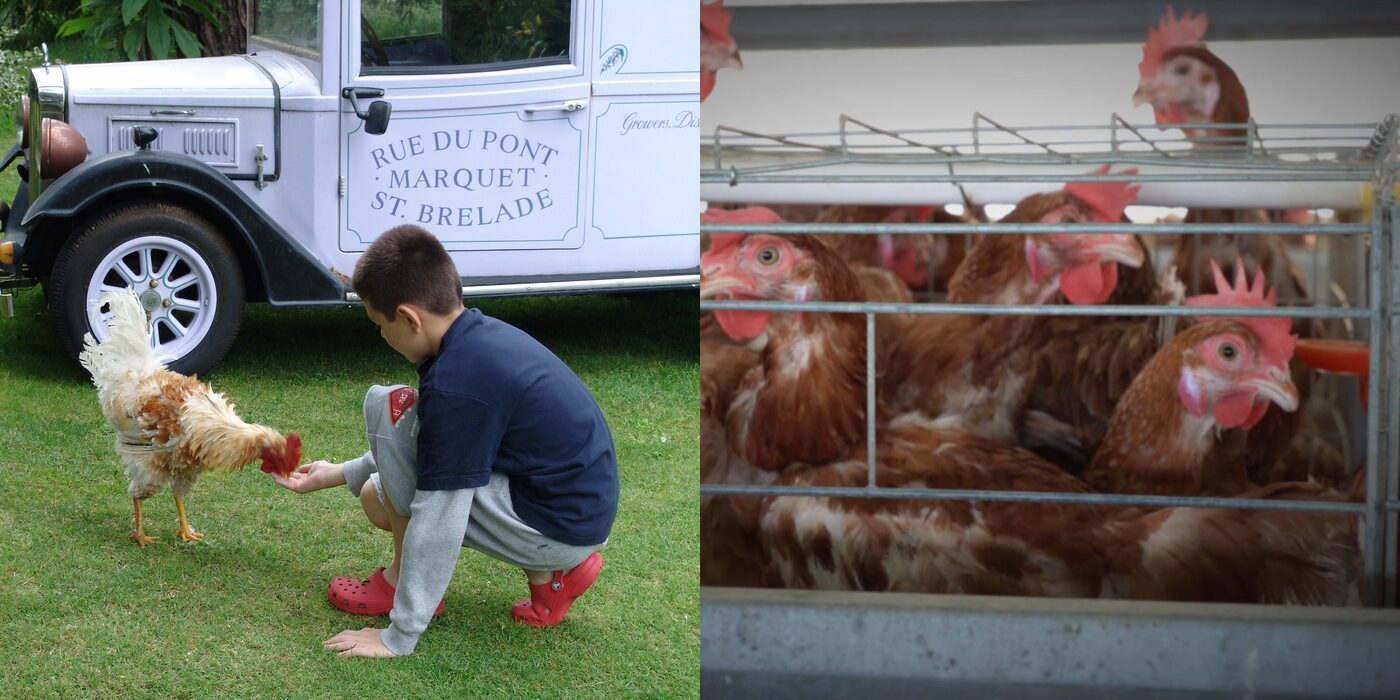
Left: How I (at least subconsciously) imagined chicken lives. Right: How most egg-laying hens in the world today live (image: Lever Foundation).

That said, I knew there was animal suffering in parts of the supply chain, and actually gave money to animal welfare charities. I think my brain reasoned 'oh yeah conditions in some places are bad, but that's just the extremes' without realising it's really the norm. In hindsight this might have been some cognitive dissonance defence mechanism: my brain dissociating the suffering of animals from the meat I was consuming, or filing it away as 'rare extremes' to avoid the conflict of me caring about animals and eating meat. Unfortunately monkey brains sometimes make silly mistakes.
What changed?
A month ago, a work colleague kindly invited me to a lunch on animal welfare. It was useful hearing people's paths into animal welfare, and I received several great read/watch recommendations. I also got many solutions to the challenge of being a vegan or vegetarian in semi-adversarial environments. (My favourite tip: always bring a bag of vegan protein powder while travelling for work, so you don't have to worry about hitting protein from work food.)
I had last week off, so got to digesting these resources. I ended up:
- Watching Dominion
- My initial reaction was "this seems bad, but also clearly has an agenda - is this actually how the meat I eat is produced, or is this showing only the worst extremes?"
- After digging more into this, including with Claude's help, I concluded that much of what is shown reflects realistic conditions for most animal farming. Particularly convincing was documentation from the farming industry itself, as one might obviously expect the opposite agenda - and even that describes or even advocates for fairly horrific practices.
- I think animal advocacy work clarifying the fairly horrific 'average case', ideally relying on less biased/anecdoty sources, would be more convincing to people like me.
- Reading up on the EA Forum, especially posts by Bentham's Bulldog (Substack). They had a lot of links between their pages, and wrote in a way that was fairly convincing and entertaining, so I ended up exploring a lot here. Alongside this I'd fact check or dig into claims with Claude, as well as use it to help poke holes in my own ethical reasoning. (As an aside, I'm also leaning towards caring about insect welfare and have significantly changed my view on wild animal suffering.)
- I also spoke with Claude about putting the above into practice, e.g. planning a shopping list to try things I might like, or generating vegan recipe ideas. This made things feel more achievable and approachable.
There's a fair bit of debate over what exactly vegetarianism and veganism is. Online communities around them, especially veganism, can sadly appear unwelcoming because of this strict gatekeeping of definition.
Because of my animal welfare motivations for vegetarianism or veganism, while also trying to balance having positive impact in other parts of my life, the very nitpicky definition I'm using is:
Avoiding personally-attributable actions that non-negligibly counterfactually incentivize net animal suffering and slaughter relative to the benefit it brings me, to the extent reasonable while living a "normalish" life
This would make the following actions allowable:
- Buying fruit and veg, including that which has used reasonable quantities of insecticide or factory-farmed animal manure (where that farm treats manure as a near-zero-value by-product)
- Buying eggs, dairy products, and honey produced in standard commercial ways
- Buying oysters and mussels
- Putting down 'vegetarian' or 'vegan' as my dietary requirements for an event
- Eating eggs given to me as a meal, where I expect refusing it would send some form of demand signal to avoid this in future
- Eating a plant-based burger with incidental contamination from a meat burger when it touched on the grill (but not intentional contamination)
- Eating meat that would otherwise be disposed of/unused, where this does not create any demand for more meat, for example roadkill or a fully-counterfactual food waste collection through something like Olio
- Accept treatment from an animal-flesh-derived live-saving drug, at reasonable ratios
- Take paracetamol for a headache, when it has 1/8 millionth of a cow's tallow (which is largely just a cow slaughter by-product)
- Killing a parasitic insect like a tick, parasitic worm or mosquito
- Going for a walk to the shops, and accidentally stepping on an insects on the way
- Causing animals who are likely to have net-negative or neutral lives not to be born, e.g. by covering a water source to prevent mosquitoes from reproducing
And the following disallowable:
- Buying meat or leather products
- Not putting down any dietary requirement for an event, where I expect putting down a requirement would change upstream food demand slightly
- Eating meat given to me as a meal, where I expect refusing it would send some form of demand signal to avoid this in future
I have tried to pick several borderline cases to sharpen the boundary of the definition; I appreciate reasonable people will disagree about which side of the line these fall on! Although in practice, most of the impact will likely happen quite far away from the boundary.
I also recognize that "relative to the benefit it brings me" is in some ways quite selfish, and "to the extent reasonable" is quite vague, but I think together they still results in a large behaviour shift from my previous position and in line with what most people would consider vegetarian. And having some reasonable flexibility will make me more likely to stick with this: dieting research finds flexible rules beat rigid all-or-nothing rules for actually sticking to a diet, and with 84% of people who try vegetarianism or veganism eventually lapsing, sticking with it is where the long-term animal welfare impact is.
I think "and slaughter" is a bit arbitrary, and especially eggs or honey feel odd to allow (as others have noticed). This is why I think I'm likely to go vegan, or at least exclude these two.
Almonds and avocadoes seem borderline to me; the common argument is that almost all standard production of them requires farmed bees which suffer (or don't?). I feel I just don't know enough. Luckily I'm not a big almond consumer anyways.
And to consider myself vegan:
Same as above, but drop "and slaughter"
Which would move the following from the 'allowable' to 'disallowable' lists:
- Buying eggs, dairy products, and honey produced in standard commercial ways
- Putting down 'vegetarian' as my dietary requirements for an event
- Eating eggs given to me as a meal, where I expect refusing it would send some form of demand signal to avoid this in future
(I'd still buy oysters and mussels, eat roadkill/to-be-disposed meat, kill parasites, accept a life-saving drug, take paracetamol, and be fine with incidental traces)
I think it probably also makes sense to go vegan, but that's a slightly more disruptive change I'd need to think a little harder about (e.g. B12 supplementation, getting protein, understanding the ethics of milk vs my enjoyment of it4This is probably because I'm uninformed about the area, not that I am informed and am struggling to weigh known quantities.
, learning more about whether it is nutritionally healthy)."Traditional" animal advocacy content is pretty bad, and maybe net harmful?
As a side note I also interacted with a bit of maybe more 'traditional' animal advocacy content other than Dominion, such as Viva, Peta, and The Vegan Society.
I read most of their intro content, and feel these were fairly poor. They describe animal suffering as quite an abstract problem, without giving much sense of perspective or scale, or tying that back to actions people can take.
They also make a lot of obviously one-sided or hollow health claims, which makes them appear untrustworthy and in bad faith - not someone I'd want to trust my health or a significant life decision to. For example, correctly noting meat has high saturated fat content which is associated with heart disease, but then singing the praises of vegan cheese while neglecting to mention it has far more saturated fat! Or claiming that animal products often harbour harmful bacteria that cause food poisoning, without mentioning that plant-based products do the same.
Many claims around vegan alternatives also seem untrue from my lived experience, which makes me trust them much less - e.g. Viva on vegan cheese: "you would often be hard pressed to tell the difference [between traditional and vegan cheese]!"
I also found some content, like this Viva blog about Alex O'Connor, actively negative - it felt like they were bringing out the pitchforks and recklessly or intentionally misconstruing a reasonable ally, and were therefore untrustworthy and unreasonable folks I wouldn't want to associate with.5My brief and limited understanding of the situation is that:
- Alex O'Connor, a philosophy YouTuber known as Cosmic Skeptic, is an advocate for veganism and averting animal suffering
- Alex himself was a vegan for several years
- Alex suffers from severe IBS (unrelated to veganism), a medical condition that causes digestive issues.
- With his role involving lots of travel and public speaking, vegan options for eating were even more restricted. Given his IBS further significantly restricting things on top, this made keeping to a vegan diet while staying healthy in his scenario impracticable.
To me, the above seems like a reasonable, if slightly saddening result (not so much about what it says about Alex, but more what it says of the difficulty of being vegan right now).
Viva's blog seemed to recklessly or intentionally misconstrue Alex's position, implying Alex said that one can't be healthy with a vegan diet at all. I claim Viva's blog reasonably implies this given:
- The blog title "Is Veganism Healthy? A Response to Alex O’Connor" suggests Alex was arguing against veganism being healthy (which is not true: Alex argued it was not healthy in his specific scenario)
- Arguments usually imply the other person takes the other view, which was not the case for Viva's listed arguments:
- factory farming is bad (fully aligned with to Alex's view!)
- Viva's author is vegan and has run marathons and ultramarathons (anecdotal, and not opposed to Alex's view)
- dieticians agree that a well-planned, plant-based diet is suitable for all (aligned with Alex's view! but Alex argues that it is not practical given his constraints to be well-planned)
- "Every nutrient that the human body needs can be obtained from a well-planned vegan diet" (aligned with Alex's view, and again the issue at stake is practicality in his situation)
- "[veganism is] the most sustainable and cheapest diet [...] debunking any claims that a healthy vegan diet is not accessible to all" (Alex didn't argue about sustainability or price, but does argue it wasn't accessible to him, which seems reasonable. I think Viva's assertion that it's cheap therefore means it's accessible seems wrong - there can be many barriers other than price that make something inaccessible, e.g. shops or restaurants just plainly not selling sensible options.)
- Personally I have experienced many situations where there have been no vegan options for me to choose. With a lot more effort and careful planning some of these might have been avoidable, but at significant (and not always financial) cost.
- Separately I am surprised by the claim that veganism is cheaper - this is cited to an Oxford study which I'd be keen to look into more properly later. I've felt that being vegan seems a lot more expensive to hit similar nutritional goals, both for eating out and cooking at home. I could just be plain wrong on this (I imagine there are probably a lot of biases in my vibes-based hunch!), or maybe it depends on what you were eating previously? (E.g. most of my meat consumption was either free food from work or of processed chicken, or lean chicken/pork/beef mince, and my animal product consumption is likely in yoghurt, cheese, and eggs. Both of these are probably cheaper than fancy cuts of meat?)
Rather than guessing, I'd prefer we test these materials with people on the fence and iterate to make them better. Talking to users strikes again!
is more likely to convert people: welcoming them with honesty, and solutions or mitigations for the challenges to make it genuinely easy rather than just asserting it is.7It might also be possible that for veteran vegans, they do genuinely think it's easy to be vegan because they're so used to it. The curse of knowledge might be making it hard for them to empathise with people considering or new to veganism.
What feels persuasive to me
Imagine going out to a restaurant:
Anchoring on 20 days9At Nando's, you might be deciding on a main course - between a "great imitator wrap" (vegan) or a "1/2 chicken" (not vegan, duh).
Benefits of meat: The 1/2 chicken is probably slightly tastier to me. And it would give me 78.7g of protein compared to 17.4g in the wrap,8In general it does seem to be much harder to eat a high-protein low-calorie vegan diet, and nearly impossible when eating out.
However, with supplementation you can at least get in protein. In the Nando's scenario, the chicken is available for £8.70 and the wrap for £7.75. The £0.95 price differential spent on vegan protein powder would close the protein gap. For example, Protein Works Vegan Protein 360 Black is £24.29 for 2kg on Amazon, and has 87g of protein per 100g. So £0.95 × 2kg powder/£24.29 × 87g protein/100g powder = 68g protein, against a 61.3g gap.
Although this supplementation adds a bunch of calories to your diet (and it's also extra hassle, and we're comparing the raw price of bulk protein powder vs going out for a meal).
plus likely a greater range of micronutrients (although I could supplement for both). Costs of meat: 20 days9The naive "0.5 chickens × 40 days = 20 days" hides several adjustments, which happen to roughly cancel.
One big one pulls the number down. Demand elasticity: buying one less chicken doesn't remove exactly one chicken from production, because slightly lower demand nudges the price down and other buyers pick up some of the slack. Norwood & Lusk estimate forgoing a unit of chicken reduces production by about 0.76 units (though this hinges on how elastic broiler supply is, which the literature doesn't pin down well — plausibly anywhere from ~0.4 to ~0.8).
Several smaller ones push the number up. Around 5% of broilers die before slaughter (×~1.05);10The ~5% is a rough figure. It's roughly the level EFSA treats as usual, and close to the benchmark in the EU stocking-density directive (which lets farms stock more densely only if cumulative mortality stays below roughly 1% + 0.06% per day of age). Real-world flocks vary a lot with the first week accounting for a lot and a further fraction die during catching and transport, on top of the on-farm deaths.
The ~5% is a rough figure. It's roughly the level EFSA treats as usual, and close to the benchmark in the EU stocking-density directive (which lets farms stock more densely only if cumulative mortality stays below roughly 1% + 0.06% per day of age). Real-world flocks vary a lot with the first week accounting for a lot and a further fraction die during catching and transport, on top of the on-farm deaths.
a chunk of edible meat is wasted at processing, retail and on the plate, so more birds are killed than eaten (~23% of the meat entering the supply chain is lost or wasted, so I have to produce 1/(1−0.23) ≈ 1.3× the meat I eat). This doesn't double-count the pre-slaughter deaths above: that 23% is measured from the point meat enters the chain, whereas the deaths happen on the farm before that. And each broiler's parent birds (kept in factory conditions, and feed-restricted to near-constant hunger) add 2 more animal-days per bird.Put together, the central estimate lands back around 20 days, or slightly higher (0.5 × 40 × 0.76 × 1.05 × 1.3 + 2 = 22.75).
of fairly extreme animal suffering. If I imagine myself as a broiler chicken (the ones raised for meat): I'm bred to grow so fast over my 40-day lifespan that my body breaks down under me — over a quarter of broilers can't walk properly, and I'm in chronic pain from lameness, heart and lung problems, and constant hunger. I live in a shed of tens of thousands, packed so tightly by the legal maximum stocking density that there's barely room to move, amid constant noise, getting pecked, surrounded by the rotting corpses of the ~5% of us who die before slaughter.10The ~5% is a rough figure. It's roughly the level EFSA treats as usual, and close to the benchmark in the EU stocking-density directive (which lets farms stock more densely only if cumulative mortality stays below roughly 1% + 0.06% per day of age). Real-world flocks vary a lot with the first week accounting for a lot and a further fraction die during catching and transport, on top of the on-farm deaths.
I spend most of my life lying in litter soaked with faeces, inhaling ammonia and getting chemical burns on my hocks and feet. At around day 40 I'm grabbed by the legs and crammed into a crate — rough handling that fractures the legs and wings of a few percent of us — then trucked to the slaughterhouse, where I'm shackled upside down and dragged through an electrified water bath meant to stun me before my throat is cut and I'm dropped into a scalding tank to loosen my feathers. Hopefully the stun works — but even the best waterbath settings leave roughly 1 in 25 of us not properly stunned, so across billions of birds many are still conscious when their throats are cut and die by being boiled alive.11This is all if I'm a chicken lucky enough to be raised in the UK/EU, which has among the stricter welfare regimes in the world (the stocking limits, the stunning monitoring rules). In the US and much of the rest of the world the standards are weaker, so the typical broiler likely has it worse than this.
The naive "0.5 chickens × 40 days = 20 days" hides several adjustments, which happen to roughly cancel.
One big one pulls the number down. Demand elasticity: buying one less chicken doesn't remove exactly one chicken from production, because slightly lower demand nudges the price down and other buyers pick up some of the slack. Norwood & Lusk estimate forgoing a unit of chicken reduces production by about 0.76 units (though this hinges on how elastic broiler supply is, which the literature doesn't pin down well — plausibly anywhere from ~0.4 to ~0.8).
Several smaller ones push the number up. Around 5% of broilers die before slaughter (×~1.05);10The ~5% is a rough figure. It's roughly the level EFSA treats as usual, and close to the benchmark in the EU stocking-density directive (which lets farms stock more densely only if cumulative mortality stays below roughly 1% + 0.06% per day of age). Real-world flocks vary a lot with the first week accounting for a lot and a further fraction die during catching and transport, on top of the on-farm deaths.
The ~5% is a rough figure. It's roughly the level EFSA treats as usual, and close to the benchmark in the EU stocking-density directive (which lets farms stock more densely only if cumulative mortality stays below roughly 1% + 0.06% per day of age). Real-world flocks vary a lot with the first week accounting for a lot and a further fraction die during catching and transport, on top of the on-farm deaths.
a chunk of edible meat is wasted at processing, retail and on the plate, so more birds are killed than eaten (~23% of the meat entering the supply chain is lost or wasted, so I have to produce 1/(1−0.23) ≈ 1.3× the meat I eat). This doesn't double-count the pre-slaughter deaths above: that 23% is measured from the point meat enters the chain, whereas the deaths happen on the farm before that. And each broiler's parent birds (kept in factory conditions, and feed-restricted to near-constant hunger) add 2 more animal-days per bird.Put together, the central estimate lands back around 20 days, or slightly higher (0.5 × 40 × 0.76 × 1.05 × 1.3 + 2 = 22.75).
makes things much more concrete and visceral, rather than the generic and vague claims of animal suffering in standard arguments. And I get to make the trade that 'for eating something slightly less tasty, I can avoid 20 days of an animal's suffering in the awful conditions above'. This to me feels like a no-brainer: a deal I'd be excited to take rather than feel an obligation to.12A related parable is Joe Carlsmith's variation on Peter Singer's thought experiment.
Eating at home it's a similar trade-off, but stacked even more against meat. There's a greater selection of interesting and nutritional vegetarian and vegan options, which for some reason are usually relatively tastier than restaurant-provided non-meat options.2I'm confused why restaurant veggie/vegan food is so much worse than the meat option. When I cook myself, vegan food is 95%+ as nice if not nicer than meat dishes I cook. But most restaurants provide pretty bad vegan options, and even if they succeed at making something that tastes good it's usually terrible in terms of nutrition.
If anyone knows a restaurant that has affordable, low-calorie high-protein, vegan meals in London please tell me. My current list is:
- [this page is intentionally left blank]
(Govinda's is affordable but is pretty unhealthy: very high in oil and low in protein, it has a poor food hygiene rating, and generally poor/confusing food labelling - e.g. they claim everything is "100% vegan-friendly" but then sell paneer cheese. It might be possible to use their À La Carte menu to stack up on dahl and beans enough to mitigate this; I think someone could argue me into this moving to the list. I do like going to Govinda's.
George Farha Cafe offers a very affordable Tofu & Rice, but it's very carb and oil heavy.
Indian YMCA is affordable but their vegan option is also very high in oil and low in protein. It might be possible to stack up on dahl if you ask the servers nicely though.
Indian Veg on Chapel Market is borderline on this list. Given it's a buffet, and you can stack hard on the protein heavy hitters e.g. the vegan lentil or chickpea dahls. It's £14.95, which is by no means expensive, especially if you tackle it like a buffet and go up for many plates of food. But it doesn't really hit the same price point as say Pret.
Pret, speaking of, is affordable and has some vegan options, but again none are very high protein. The highest protein vegan main is currently the Humous & Chipotle Wrap, which only offers a paltry 12g of protein for 394 kcal.
Supermarkets are probably the best option for vegan food, and rawdogging a block of tofu might be The Way (okay maybe not... but it might be better than some options). Over the last few months I've actually gone to Lidl for most of my office lunches and dinners. I buy a bunch of veg, plus some protein topper, and prepare myself a salad.)
This isn't free: things on the veggie/vegan side aren't perfect as some claim - I'd miss yoghurt and ice cream a lot, and animal mince and eggs a little. But my enjoyment of those foods feels much smaller than the suffering averted, and I also enjoy trying many new things I wouldn't have discovered if not for being veggie, e.g. many soy protein alternatives. And these trade-offs seem to be reducing over time as better substitutes are developed and become more available. (I appreciate I have preferences that make being veggie a lot easier, e.g. love of fruit, enjoy a lot of simple vegetables, preference for consistent textures and tastes, happy to try new weird vegan stuff, actively dislike the taste of many animal products e.g. chicken thigh, milk and lamb.)
I'm still confused and figuring things out
Overall I'm pretty surprised that I was so ignorant about this for so long, and grateful12A related parable is Joe Carlsmith's variation on Peter Singer's thought experiment.
that I'm now aware and can change my behaviour. It's also triggered me to reassess whether there are other places my ethics seem wonky.13So far there haven't been any other big updates.
The couple minor updates outside animal welfare:
- Refreshed my belief that global health and development work is amazingly effective, compared to most forms of charity. I 'knew' this before, and at times was really motivated by it, but that motivation has waned as I've been more focused on existential risks. Reducing existential risk from AI remains a higher priority for me right now, but reading into this again does make me more emotionally (rather than just intellectually) excited for solving global health and development challenges post-AGI.
- How much of a problem climate change will be has larger error bars than I thought it did. But I remain fairly confident that according to my values I am prioritizing it appropriately.
I remain very confused about a lot of animal welfare, including:
- How much does personal impact really make sense, e.g. compared to offsetting or donations? Especially considering I don't eat that many animal products to begin with, or might be happier donating (relatively) a lot of money while still eliminating most of the animal suffering attributable to me. But I agree with the intuition "it’s not typically thought that an assassin can get off scot-free by donating a few thousand bucks to the Against Malaria Foundation each time they perform an assassination".
- I think the strongest argument for not going vegan is actually presented in this post arguing against offsets, "some EAs I have spoken to are afraid that going vegan will reduce their productivity or earnings by more than $276/year. If this were true, then I wholeheartedly endorse their decision to eat an omnivorous diet and donate their extra earnings wherever they please."14
To be clear, it's not that this post nudged me more towards not being vegan. Just that I think it expresses the objection that I already had in clear words.
I think this plausibly is true for strict veganism for me (but probably not for say reducing my consumption of animal products by 80%). - This post's analogy also maybe changed my mind about the importance of personal impact:
[expecting veganism] is the most visible symptom of a broken movement culture causing us to (accidentally) hold a very high bar of commitment [to get involved in animal welfare], pushing away a wide swath of people early on, right as they are getting oriented.
Imagine if climate activism were gatekept based on whether you, personally, restrict to only electric transit. In this world, common icebreaker questions are “how long have you been electric?” and “how many miles does your car get on a full charge?” You might have taken a diesel train to get there but you definitely shouldn’t mention it. If you took an Uber and the car that picked you up was a hybrid, you’re expected to, at a minimum, request them to turn off the gas engine while driving you to your destination.
- I think the strongest argument for not going vegan is actually presented in this post arguing against offsets, "some EAs I have spoken to are afraid that going vegan will reduce their productivity or earnings by more than $276/year. If this were true, then I wholeheartedly endorse their decision to eat an omnivorous diet and donate their extra earnings wherever they please."14
- Is a vegan diet actually healthy? There's good evidence you'll probably be healthy in the short term, and it helps reduce some long term health risks especially cardiovascular health. But there's a fair bit of evidence that being vegan may cause health issues elsewhere, and correlates with some longer term health problems (although other folks find reduced all-cause mortality). In general humanity just doesn't understand most things in the world very well, and that includes nutrition. This alone doesn't mean we should presuppose meat eating is healthy - but we seem to have evolved as omnivores, so we're probably more likely to operate most effectively as omnivores? And "where we know the most about how to eat healthy" is likely to be adjustments around a typical omnivore diet.
- If personal impact does make sense and is safe, should I just go vegan? Vegetarianism seems like a fairly arbitrary line in the sand that I struggle to justify.
- Or at least give up eggs? Or at least eggs that I can't show weren't factory farmed? Then I'd basically be vegan except for some dairy products.
- More boringly, I need to figure out practicalities: ensuring I'm getting enough B12, plus probably other things, and maybe getting my baseline blood levels tested for nutritional deficiencies. I currently get most of my protein from yoghurt and cheese so will need to reconfigure my diet a bit, and find meals I like. (I also think I do really like yoghurt and cheese, and want to find good alts/be sure I'm happy with the trade before committing to it very publicly. This feels very selfish, e.g. weighing some torture of an innocent living being to 'hmm i do kinda like yoghurt!'. I don't have a good answer to this, but I'd rather be open about this awkward unresolved tension than pretend it doesn't exist!). Making my environment vegan-friendly first seems helpful though given behaviour-change research emphasises that behaviour needs opportunity, not just motivation, so stocking up on vegan foods I'm confident I like will make it much more likely I stick with veganism.
- In theory at least, animals can be kept in better conditions, e.g. a genuinely high standard free range. Would I feel okay eating these animal products, and under what scenarios? In practice I don't need to resolve this now as the meat industry is such a mess this basically doesn't exist (especially in my problem case of eating out, where there's almost no animal welfare info).
- This does feel like the point where I'm most likely to diverge with many vegetarians/vegans, and means my case rests on the facts rather than a principle: it leans on today's extreme imbalance between my enjoyment and the animal's suffering, so if welfare standards improved massively I'd have to redo the maths. A weird part of my monkey brain feels like this makes me a 'fake' vegetarian/vegan, and discourages me from becoming one - luckily my system 2 brain knows better! I'm happy for my position to be: right now I can be vegetarian/maybe vegan, and if we're luckily enough to enter a world where animals live good lives I can celebrate the huge win and reassess, not fear that world!
- Common arguments for more durable vegetarianism are:
- Killing animals = bad. You'd think this would be pretty simple, but I'm uncertain how bad killing is; I think I worry much more about the suffering or lost opportunity of happiness. But farming might be okay if animals lived neutral or positive lives. (Positive is actually the trickier case, because a deprivationist view of death suggests this causes lost opportunity, which I think aligns with my views on death - as opposed to say an Epicurean view which says this lost opportunity shouldn't be counted. But if we didn't farm animals at all, then they wouldn't exist at all, so on net the system of farming is positive.).
- Sentient beings are not ours to use as we please, and doing so is wrong in itself, regardless of how good their lives are. I don't have a strong intuition that using a sentient animal is wrong in itself, and it feels like you probably do need a virtue ethics view + this belief to follow this argument. Though I'd still feel it'd be wrong to farm happy humans living net positive lives just because they were tasty, so maybe I do hold some amount of this principle after all, or at least have some incongruence in my ethical beliefs here. Still working on this one...
- Returning wildlife or habitats to the natural way of things is good, and animal agriculture runs counter to this. I think this is by far the least convincing argument to me given nature seems awful.
I'm excited to continue thinking hard about this, and to try pursuing vegetarianism! Even if on priors I shouldn't expect it to last (84% of vegetarians/vegans abandon their diet), I'm keen to make it work - and at the very least significantly reduce the amount I incentivise animal suffering.
Footnotes
-
There's a fair bit of debate over what exactly vegetarianism and veganism is. Online communities around them, especially veganism, can sadly appear unwelcoming because of this strict gatekeeping of definition.
Because of my animal welfare motivations for vegetarianism or veganism, while also trying to balance having positive impact in other parts of my life, the very nitpicky definition I'm using is:
Avoiding personally-attributable actions that non-negligibly counterfactually incentivize net animal suffering and slaughter relative to the benefit it brings me, to the extent reasonable while living a "normalish" life
This would make the following actions allowable:
- Buying fruit and veg, including that which has used reasonable quantities of insecticide or factory-farmed animal manure (where that farm treats manure as a near-zero-value by-product)
- Buying eggs, dairy products, and honey produced in standard commercial ways
- Buying oysters and mussels
- Putting down 'vegetarian' or 'vegan' as my dietary requirements for an event
- Eating eggs given to me as a meal, where I expect refusing it would send some form of demand signal to avoid this in future
- Eating a plant-based burger with incidental contamination from a meat burger when it touched on the grill (but not intentional contamination)
- Eating meat that would otherwise be disposed of/unused, where this does not create any demand for more meat, for example roadkill or a fully-counterfactual food waste collection through something like Olio
- Accept treatment from an animal-flesh-derived live-saving drug, at reasonable ratios
- Take paracetamol for a headache, when it has 1/8 millionth of a cow's tallow (which is largely just a cow slaughter by-product)
- Killing a parasitic insect like a tick, parasitic worm or mosquito
- Going for a walk to the shops, and accidentally stepping on an insects on the way
- Causing animals who are likely to have net-negative or neutral lives not to be born, e.g. by covering a water source to prevent mosquitoes from reproducing
And the following disallowable:
- Buying meat or leather products
- Not putting down any dietary requirement for an event, where I expect putting down a requirement would change upstream food demand slightly
- Eating meat given to me as a meal, where I expect refusing it would send some form of demand signal to avoid this in future
I have tried to pick several borderline cases to sharpen the boundary of the definition; I appreciate reasonable people will disagree about which side of the line these fall on! Although in practice, most of the impact will likely happen quite far away from the boundary.
I also recognize that "relative to the benefit it brings me" is in some ways quite selfish, and "to the extent reasonable" is quite vague, but I think together they still results in a large behaviour shift from my previous position and in line with what most people would consider vegetarian. And having some reasonable flexibility will make me more likely to stick with this: dieting research finds flexible rules beat rigid all-or-nothing rules for actually sticking to a diet, and with 84% of people who try vegetarianism or veganism eventually lapsing, sticking with it is where the long-term animal welfare impact is.
I think "and slaughter" is a bit arbitrary, and especially eggs or honey feel odd to allow (as others have noticed). This is why I think I'm likely to go vegan, or at least exclude these two.
Almonds and avocadoes seem borderline to me; the common argument is that almost all standard production of them requires farmed bees which suffer (or don't?). I feel I just don't know enough. Luckily I'm not a big almond consumer anyways.
And to consider myself vegan:
Same as above, but drop "and slaughter"
Which would move the following from the 'allowable' to 'disallowable' lists:
- Buying eggs, dairy products, and honey produced in standard commercial ways
- Putting down 'vegetarian' as my dietary requirements for an event
- Eating eggs given to me as a meal, where I expect refusing it would send some form of demand signal to avoid this in future
(I'd still buy oysters and mussels, eat roadkill/to-be-disposed meat, kill parasites, accept a life-saving drug, take paracetamol, and be fine with incidental traces) ↩ ↩2
-
I'm confused why restaurant veggie/vegan food is so much worse than the meat option. When I cook myself, vegan food is 95%+ as nice if not nicer than meat dishes I cook. But most restaurants provide pretty bad vegan options, and even if they succeed at making something that tastes good it's usually terrible in terms of nutrition.
If anyone knows a restaurant that has affordable, low-calorie high-protein, vegan meals in London please tell me. My current list is:
- [this page is intentionally left blank]
(Govinda's is affordable but is pretty unhealthy: very high in oil and low in protein, it has a poor food hygiene rating, and generally poor/confusing food labelling - e.g. they claim everything is "100% vegan-friendly" but then sell paneer cheese. It might be possible to use their À La Carte menu to stack up on dahl and beans enough to mitigate this; I think someone could argue me into this moving to the list. I do like going to Govinda's.
George Farha Cafe offers a very affordable Tofu & Rice, but it's very carb and oil heavy.
Indian YMCA is affordable but their vegan option is also very high in oil and low in protein. It might be possible to stack up on dahl if you ask the servers nicely though.
Indian Veg on Chapel Market is borderline on this list. Given it's a buffet, and you can stack hard on the protein heavy hitters e.g. the vegan lentil or chickpea dahls. It's £14.95, which is by no means expensive, especially if you tackle it like a buffet and go up for many plates of food. But it doesn't really hit the same price point as say Pret.
Pret, speaking of, is affordable and has some vegan options, but again none are very high protein. The highest protein vegan main is currently the Humous & Chipotle Wrap, which only offers a paltry 12g of protein for 394 kcal.
Supermarkets are probably the best option for vegan food, and rawdogging a block of tofu might be The Way (okay maybe not... but it might be better than some options). Over the last few months I've actually gone to Lidl for most of my office lunches and dinners. I buy a bunch of veg, plus some protein topper, and prepare myself a salad.) ↩ ↩2
-
This is a sign of learning at least I guess! ↩
-
This is probably because I'm uninformed about the area, not that I am informed and am struggling to weigh known quantities. ↩
-
My brief and limited understanding of the situation is that:
- Alex O'Connor, a philosophy YouTuber known as Cosmic Skeptic, is an advocate for veganism and averting animal suffering
- Alex himself was a vegan for several years
- Alex suffers from severe IBS (unrelated to veganism), a medical condition that causes digestive issues.
- With his role involving lots of travel and public speaking, vegan options for eating were even more restricted. Given his IBS further significantly restricting things on top, this made keeping to a vegan diet while staying healthy in his scenario impracticable.
To me, the above seems like a reasonable, if slightly saddening result (not so much about what it says about Alex, but more what it says of the difficulty of being vegan right now).
Viva's blog seemed to recklessly or intentionally misconstrue Alex's position, implying Alex said that one can't be healthy with a vegan diet at all. I claim Viva's blog reasonably implies this given:
- The blog title "Is Veganism Healthy? A Response to Alex O’Connor" suggests Alex was arguing against veganism being healthy (which is not true: Alex argued it was not healthy in his specific scenario)
- Arguments usually imply the other person takes the other view, which was not the case for Viva's listed arguments:
- factory farming is bad (fully aligned with to Alex's view!)
- Viva's author is vegan and has run marathons and ultramarathons (anecdotal, and not opposed to Alex's view)
- dieticians agree that a well-planned, plant-based diet is suitable for all (aligned with Alex's view! but Alex argues that it is not practical given his constraints to be well-planned)
- "Every nutrient that the human body needs can be obtained from a well-planned vegan diet" (aligned with Alex's view, and again the issue at stake is practicality in his situation)
- "[veganism is] the most sustainable and cheapest diet [...] debunking any claims that a healthy vegan diet is not accessible to all" (Alex didn't argue about sustainability or price, but does argue it wasn't accessible to him, which seems reasonable. I think Viva's assertion that it's cheap therefore means it's accessible seems wrong - there can be many barriers other than price that make something inaccessible, e.g. shops or restaurants just plainly not selling sensible options.)
- Personally I have experienced many situations where there have been no vegan options for me to choose. With a lot more effort and careful planning some of these might have been avoidable, but at significant (and not always financial) cost.
- Separately I am surprised by the claim that veganism is cheaper - this is cited to an Oxford study which I'd be keen to look into more properly later. I've felt that being vegan seems a lot more expensive to hit similar nutritional goals, both for eating out and cooking at home. I could just be plain wrong on this (I imagine there are probably a lot of biases in my vibes-based hunch!), or maybe it depends on what you were eating previously? (E.g. most of my meat consumption was either free food from work or of processed chicken, or lean chicken/pork/beef mince, and my animal product consumption is likely in yoghurt, cheese, and eggs. Both of these are probably cheaper than fancy cuts of meat?)
-
Rather than guessing, I'd prefer we test these materials with people on the fence and iterate to make them better. Talking to users strikes again! ↩
-
It might also be possible that for veteran vegans, they do genuinely think it's easy to be vegan because they're so used to it. The curse of knowledge might be making it hard for them to empathise with people considering or new to veganism. ↩
-
In general it does seem to be much harder to eat a high-protein low-calorie vegan diet, and nearly impossible when eating out.
However, with supplementation you can at least get in protein. In the Nando's scenario, the chicken is available for £8.70 and the wrap for £7.75. The £0.95 price differential spent on vegan protein powder would close the protein gap. For example, Protein Works Vegan Protein 360 Black is £24.29 for 2kg on Amazon, and has 87g of protein per 100g. So £0.95 × 2kg powder/£24.29 × 87g protein/100g powder = 68g protein, against a 61.3g gap.
Although this supplementation adds a bunch of calories to your diet (and it's also extra hassle, and we're comparing the raw price of bulk protein powder vs going out for a meal). ↩
-
The naive "0.5 chickens × 40 days = 20 days" hides several adjustments, which happen to roughly cancel.
One big one pulls the number down. Demand elasticity: buying one less chicken doesn't remove exactly one chicken from production, because slightly lower demand nudges the price down and other buyers pick up some of the slack. Norwood & Lusk estimate forgoing a unit of chicken reduces production by about 0.76 units (though this hinges on how elastic broiler supply is, which the literature doesn't pin down well — plausibly anywhere from ~0.4 to ~0.8).
Several smaller ones push the number up. Around 5% of broilers die before slaughter (×~1.05);10The ~5% is a rough figure. It's roughly the level EFSA treats as usual, and close to the benchmark in the EU stocking-density directive (which lets farms stock more densely only if cumulative mortality stays below roughly 1% + 0.06% per day of age). Real-world flocks vary a lot with the first week accounting for a lot and a further fraction die during catching and transport, on top of the on-farm deaths.
a chunk of edible meat is wasted at processing, retail and on the plate, so more birds are killed than eaten (~23% of the meat entering the supply chain is lost or wasted, so I have to produce 1/(1−0.23) ≈ 1.3× the meat I eat). This doesn't double-count the pre-slaughter deaths above: that 23% is measured from the point meat enters the chain, whereas the deaths happen on the farm before that. And each broiler's parent birds (kept in factory conditions, and feed-restricted to near-constant hunger) add 2 more animal-days per bird.Put together, the central estimate lands back around 20 days, or slightly higher (0.5 × 40 × 0.76 × 1.05 × 1.3 + 2 = 22.75). ↩ ↩2
-
The ~5% is a rough figure. It's roughly the level EFSA treats as usual, and close to the benchmark in the EU stocking-density directive (which lets farms stock more densely only if cumulative mortality stays below roughly 1% + 0.06% per day of age). Real-world flocks vary a lot with the first week accounting for a lot and a further fraction die during catching and transport, on top of the on-farm deaths. ↩ ↩2
-
This is all if I'm a chicken lucky enough to be raised in the UK/EU, which has among the stricter welfare regimes in the world (the stocking limits, the stunning monitoring rules). In the US and much of the rest of the world the standards are weaker, so the typical broiler likely has it worse than this. ↩
-
A related parable is Joe Carlsmith's variation on Peter Singer's thought experiment. ↩ ↩2
-
So far there haven't been any other big updates.
The couple minor updates outside animal welfare:
- Refreshed my belief that global health and development work is amazingly effective, compared to most forms of charity. I 'knew' this before, and at times was really motivated by it, but that motivation has waned as I've been more focused on existential risks. Reducing existential risk from AI remains a higher priority for me right now, but reading into this again does make me more emotionally (rather than just intellectually) excited for solving global health and development challenges post-AGI.
- How much of a problem climate change will be has larger error bars than I thought it did. But I remain fairly confident that according to my values I am prioritizing it appropriately.
-
To be clear, it's not that this post nudged me more towards not being vegan. Just that I think it expresses the objection that I already had in clear words. ↩