Thinking tool: Become a narrow expert

Always strive to become an expert in your problem.
People seem to have different mental blocks around this, but one of the most common is believing that if it touches an area where specialised domain expertise (say cybersecurity or law) is required they can't have opinions on it anymore.
However, it's often surprisingly easy for you to become an expert in a narrow part of that expertise. Security or legal professionals aren't aliens or wizards that possess some magic unobtainable skill; they put in the work to build their expertise in these areas. You can too! And because you have to understand a much more narrow case, say the security details about your one specific feature, it's reasonable to expect that you can catch up with them on this narrow thing in a fairly short time because you're trading off breadth of knowledge.
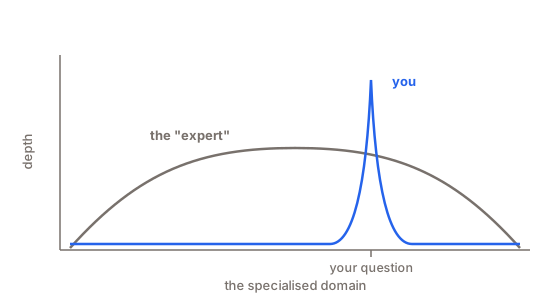
Of course, you should still defer to experts in their domain of expertise. In fact, learning from experts is one of the best ways for you to upskill! Additionally, experts might bring considerations that you wouldn't naturally come up with, or have know-how that might not be obvious as a novice to the field. This is not "override experts in their fields", but is instead "be willing to develop calibrated novice intuitions that you're trying to improve on".
AI models like Claude can be a massive help here, when used well. By well, I mean behaviour like:
- Ask precise questions (and follow-up questions) to build out your models and knowledge of the space.
- Put things in your own words, and notice and dig into points of confusion or where you think there are contradictions. Being sceptical can be a huge help here.
- Challenge your thoughts or understanding with AI, e.g. "why might this idea be wrong" or "give me practice questions to test my understanding of this"
- Request simple explanations of concepts that you're unfamiliar with or explain documents you've been sent by experts. A good trick here is to have it use analogies from fields you are more familiar with e.g. "I'm a full-stack software engineer; use analogies I'd resonate with to explain <concept>"
- Be AI-legible so that these tools understand the context in which you're making decisions and are able to tailor advice accordingly.
(Poor use is stuff like churning out slop that you don't understand, or nodding along to things that sound right without actively processing them. A lot of this is just learning science 101.)
Related concepts
This is part of my thinking tools series. Also consider:
- Be sceptical: expertise is mostly knowing which "why?"s to ask next
- Be AI-legible: AI can do the first hundred hours of reading much better when it can see your actual context